TNERC Approves TNGECL’s 1,000 MWh Battery Storage Power Purchase
The approved tariffs range from ₹246,000/MW/month to ₹248,000/MW/month
December 10, 2025
Follow Mercom India on WhatsApp for exclusive updates on clean energy news and insights
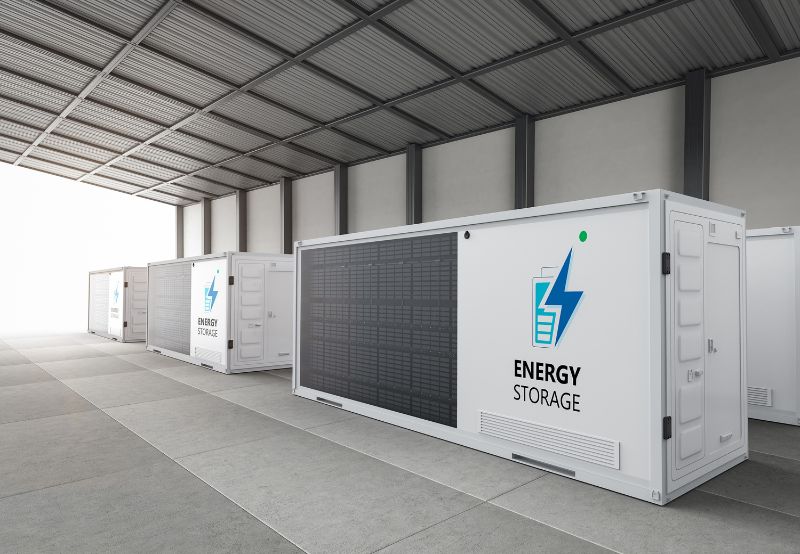
The Tamil Nadu Electricity Regulatory Commission (TNERC) has approved Tamil Nadu Green Energy Corporation’s (TNGECL) purchase of 1,000 MWh of power from battery energy storage systems (BESS) located at six substations of Tamil Nadu Transmission Corporation.
Background
TNGECL had approached the Commission seeking approval to procure power from utility-scale standalone BESS.
Tamil Nadu has experienced rising renewable penetration and significant variability from its wind and solar installations. The petitioner contended that this has increased the stress on thermal generators and complicated grid management. Pumped storage projects are under development but require long construction timelines. Battery storage is the only viable near-term option for integrating renewable energy smoothly while supporting peak demand.
The petitioner explained that the union government had launched a viability gap funding (VGF) program for BESS and had allocated 1,000 MWh to Tamil Nadu under the program’s state component. Under this framework, up to 30% of the project cost would be provided as a grant.
TNGECL submitted that VGF would reduce the financial burden on the distribution licensee and argued that Tamil Nadu must utilize this allocation without delay. The plan involved establishing 500 MW across two discharge cycles, totaling 1,000 MWh, at six substations spread across the state. TNGECL would conduct the tender and manage the project on behalf of Tamil Nadu Power Distribution Corporation, which would be the procurer and the signatory to the storage purchase agreements.
TNGECL then sought permission to issue a tender inviting bids based on monthly capacity, in line with the Ministry of Power’s guidelines for storage procurement. The petitioner detailed the eligibility criteria, performance benchmarks, commissioning requirements, and financial guarantees, among other details. The Commission allowed TNGECL to proceed with the tender on the condition that it return with a tariff adoption petition before any agreement was executed.
After the tender concluded, TNGECL filed a request for ratification of the tendering process, adoption of the discovered tariffs, and approval for the issuance of letters of award. The petitioner informed the Commission that four bidders participated and three qualified. Bondada Engineering emerged as the lowest bidder at ₹246,000 (~$2,856.81)/MW/month. Oriana Power matched this tariff, and NLC India Renewables quoted a tariff of ₹248,000 (~$2,880.04)/MW/month. TNGECL proposed allocating capacities among these three firms to cover the full 500 MW output with two discharge cycles.
Commission’s Analysis
The Commission agreed that variability from renewable energy has created operational challenges and that battery storage offers an effective short-term method for stabilising the grid.
It examined the Ministry of Power’s guidelines for competitive bidding, the structure of the VGF program, and the proposed tender features. It noted that the program was designed to help states with high renewable penetration and that Tamil Nadu had been allocated 1,000 MWh.
The Commission noted that TNGECL had followed the Ministry of Power’s procedures, including the two-part bidding system and the requirement for a reverse auction. It also noted that the discovered tariffs fell below the ceiling and were in line with, or lower than, recent tariffs for similar tenders in other states.
The Commission recorded that the bidders had been evaluated in accordance with the prescribed eligibility norms and that the allocation of capacity among the three qualified bidders ensured full utilization of the VGF allotment.
The regulator also considered the relevance of the State’s renewable purchase obligation (RPO) and energy storage obligation frameworks. It observed that, under the amended RPO regulations, battery storage was not mandatory for RPO compliance but confirmed that distribution licensees may still procure storage for the purpose of resource adequacy and cost optimisation.
The Commission therefore ratified the tender as a special case, adopted the tariffs of Bondada Engineering, Oriana Power, and NLC India Renewables, and approved the issuance of letters of award and the execution of 12-year battery energy storage purchase agreements.
Subscribe to Mercom’s real-time Regulatory Updates to ensure you don’t miss any critical updates from the renewable industry.