


Solar, Battery Storage Help Lower Power Prices in California, Texas: SEIA
Rooftop solar generation increased by 4,137 GWh in California and 970 GWh in Texas
October 30, 2026

Follow Mercom India on WhatsApp for exclusive updates on clean energy news and insights
California and Texas recorded an estimated wholesale electricity cost savings of $2.5 billion and $3.55 billion, respectively, between June and August 2026 compared with the corresponding period in 2021, according to an analysis by the Solar Energy Industries Association (SEIA).
The decline in wholesale electricity prices was attributed partly to increased solar generation and battery energy storage deployment.
The analysis examined the weighted average hourly wholesale day-ahead electricity prices for June, July, and August 2021 and the same months in 2026.
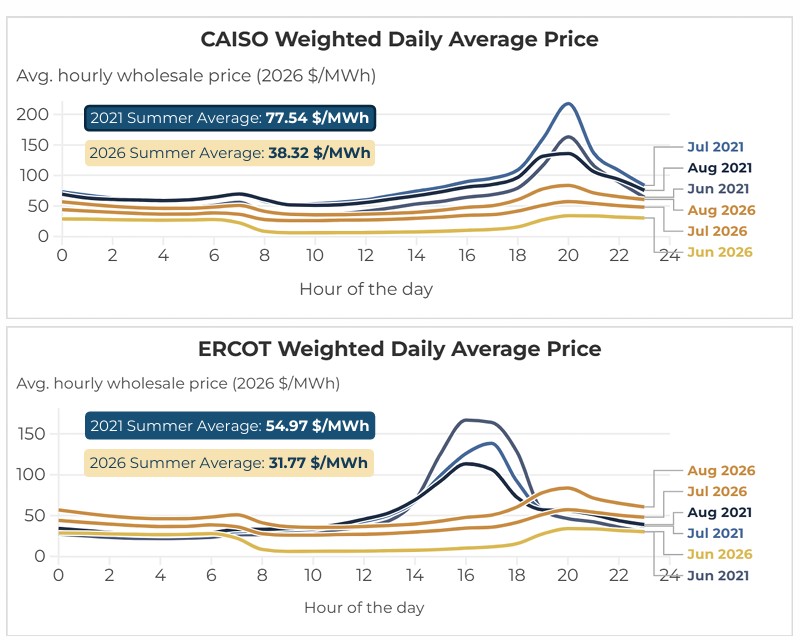
Both the Electric Reliability Council of Texas (ERCOT) and the California Independent System Operator (CAISO) saw weighted daily average prices drop over the period. After adjusting for inflation, CAISO prices declined 51% from $77.54/MWh to $38.32/MWh, while ERCOT prices declined 42% from $54.97/MWh to $31.77/MWh.
During the same period, the generation component of residential electricity prices declined by 10% in California and 4% in Texas. However, increases in other cost components pushed overall residential electricity prices up by 22% in California and 3% in Texas.
California
Average hourly electricity prices during the three summer months were significantly higher in 2021 than in 2026. Solar power generation rose 90% over the five years in California, while installed battery storage capacity grew from 8.1 GWh in 2021 to 62 GWh by the end of the first half of 2026.
According to SEIA, batteries now supply 6% to 7% of CAISO’s daily energy use.
From June to August 2026, California’s electricity consumption was 2.5% higher than during the same period in 2021, while average wholesale electricity prices were 51% lower after adjusting for inflation. The decline in wholesale electricity prices saved the state an estimated $2.5 billion.
While the generation component of residential electricity prices declined by 10%, transmission, distribution, and other costs, such as wildfire management, increased substantially.
Texas
During the three summer months, average hourly electricity prices in Texas were significantly higher in 2021 than in 2026.
Over the five years, solar power generation in Texas increased 421%. Installed battery storage capacity grew from 1 GWh in 2021 to 33.1 GWh by the end of the first half of 2026. Battery storage now supplies over 1.3% of the state’s energy demand.
From June to August 2026, Texas’ electricity consumption was 30.1% higher than in the same period in 2021, while average wholesale electricity prices were 42% lower after adjusting for inflation. The decline in wholesale electricity prices saved the state an estimated $3.55 billion.
SEIA’s comparison of residential electricity price components across selected Texas utilities shows generation costs fell by 4%, while transmission and distribution costs rose by 17% and 23%, respectively. Other electricity costs declined by 5%
Rooftop solar generation increased by 970 GWh in Texas and 4,137 GWh in California between the three-month periods of 2021 and 2026, helping meet rising electricity demand in both states.
Rooftop solar and customer-sited battery energy storage reduce grid stress and the need for additional centralized generation assets.
Texas and California face heightened permitting risks for solar and wind energy projects amid increased federal oversight, with potential delays to scheduled commercial operation dates. According to an analysis by Wood Mackenzie, projects in these states, along with Arizona, have some of the highest exposure to additional reviews under a U.S. Department of the Interior memorandum. The reviews could add uncertainty to project development timelines and investments.
According to a September report by Wood Mackenzie and SEIA, the U.S. added 11.4 GW of solar capacity in the second quarter of 2026, a 45% year-over-year increase and a 43% quarter-over-quarter increase.