


Global Battery Storage Failure Rate Dropped 98% Between 2018 and 2025: Report
Energy storage incidents fell to 24 in 2025 despite capacity rising to 634 GWh
October 30, 2026

Follow Mercom India on WhatsApp for exclusive updates on clean energy news and insights
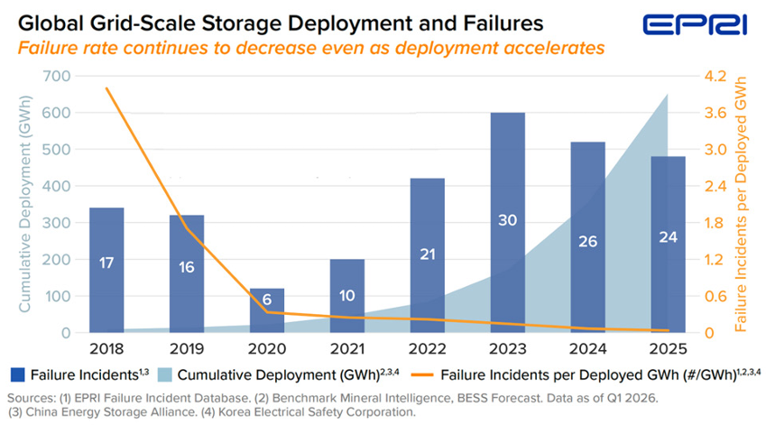
The annual failure rate of lithium-ion battery energy storage systems (BESS) declined by 98% globally from 2018 to 2025, according to a report by the Electric Power Research Institute (EPRI). The annual failure rate was calculated by analyzing incidents per GWh deployed globally.
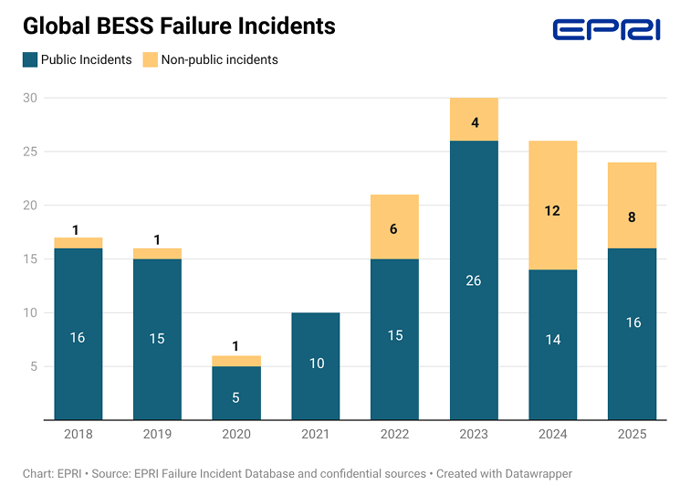
The report recorded 150 incidents during the period. In 2025, 24 incidents were recorded across 634 GWh of cumulative deployed capacity, compared with 26 incidents across 343 GWh in 2024. The annual failure rate fell 50% from 2024 to 2025.
Failure Trends
EPRI developed its failure incident database in 2021 after battery storage fires in South Korea and the 2019 Surprise, Arizona incident. The database covers utility-scale and commercial and industrial (C&I) systems, including behind-the-meter installations and uninterruptible power supplies at data centers. Residential systems and electric vehicles are excluded from the database.
The database records large-scale thermal events caused by internal faults, including arc flashes, fires, or explosions. It excludes smaller operational failures and incidents caused by external factors, including wildfires.
Of the 150 incidents, 33 (22%) were not publicly reported but were confirmed by industry experts. EPRI used media reports, government records, root cause analyses, academic publications, and industry sources. Of the 25 incidents recorded in China, 22 were not publicly reported.
EPRI cautioned that incomplete reporting could mean the actual number of incidents is higher. It also pointed out the absence of mandatory failure reporting in the U.S. and Europe.
China recorded a 99% reduction in failure rates from 2018 to 2025, followed by the U.S. at 97%, South Korea at 91%, and Europe at 85%. Oceania recorded no failures in 2025.
South Korea accounted for 55 incidents during the period, followed by the U.S. with 36, China with 25, Europe with 20, and Oceania with four. EPRI attributed the decline in failure rates to improvements in system design, manufacturing, battery management, and safety regulations.
Incidents and Public Safety
Eighteen incidents involved explosions, accounting for 12% of the total. The incidents resulted in 24 injuries and four fatalities, including one unconfirmed death. Firefighters sustained 22 injuries and three fatalities, while employees sustained two injuries and one fatality. No acute injuries among the public were reported.
EPRI found no reported cases of fires spreading beyond utility-scale battery storage facilities. In the U.S., 18 of 36 incidents caused civic disruptions, including evacuations, shelter-in-place orders, road closures, and school closures.
The report noted that battery storage fires can release toxic pollutants, although available monitoring data generally showed detectable airborne pollutants in nearby communities below public health thresholds. The January 2025 Moss Landing fire in California caused substantial battery damage and metal deposition in nearby soil. Subsequent environmental assessments found no long-term public health risks.
Risk Factors
Indoor energy storage systems were disproportionately represented in failures and sustained greater damage than outdoor containerized installations. An analysis of 68 incidents found that the median proportion of damaged capacity was 100% for indoor systems, compared with 6% for outdoor systems, excluding installations where propagation between units was impossible.
The Moss Landing fire damaged approximately 660 MWh, or 55% of installed capacity. By comparison, a September 2022 incident at the outdoor Elkhorn facility damaged 3 MWh, or 0.4% of capacity.
EPRI found that each additional year of operation was associated with a 31% reduction in failure rates after controlling for installation year. Each successive installation year was associated with a 44% reduction after controlling for system age. However, only about 3% of the deployed battery storage capacity had operated for more than five years.
Lithium iron phosphate (LFP) and nickel manganese cobalt (NMC) accounted for 96% of annual lithium-ion battery storage deployments by 2022. EPRI recorded 34 incidents involving LFP systems from 2018 to 2025 but found insufficient evidence to establish battery chemistry as an independent risk factor.
Comparison with Transformers
EPRI estimated an average annual battery storage container failure rate of 0.04% to 0.14%, comparable to large oil-filled transformers. One transformer study estimated an annual fire incidence rate of approximately 0.1%, while another reported operational failure rates of 0.32% to 0.56%.
The report calculated an aggregated battery storage failure rate of 2.087 × 10⁻⁴ incidents per MWh-year from 2018 to 2025. EPRI cautioned that limited operating history, incomplete reporting, and changing system designs limit the ability of historical failure rates to predict failures at individual projects.
The report recommended defensive incident response strategies for battery storage systems and transformers, emphasizing personnel safety, fire containment, thermal monitoring, and explosion prevention. It also recommended safety reviews, retrofits, and potentially retiring older energy storage systems that cannot meet updated safety requirements.
The rising importance of BESS integration globally has put the spotlight on the importance of safety regulations. In India, the Central Electricity Authority recently proposed technical standards covering electrical safety requirements for battery energy storage systems, electric vehicle charging stations, transmission systems, solar, wind and other electrical installations.
The policy move came amid concerns raised by solar developers about high temperatures posing a key risk for battery storage projects, especially in renewable energy-rich states like Rajasthan and Gujarat, where summer temperatures often exceed 40°C.


Parth Shukla
More articles from Parth Shukla.