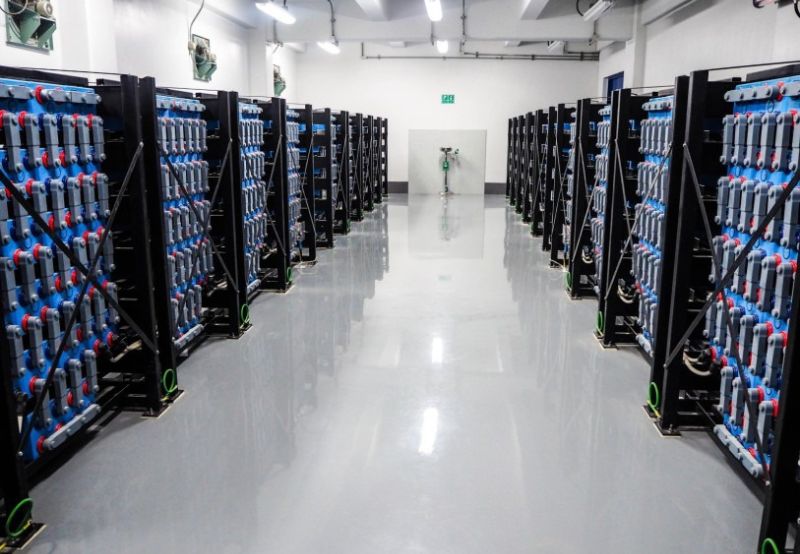
Nash Energy Commissions 2 GWh Battery Pack Manufacturing Line in Karnataka
The manufacturing line will produce batteries ranging from 100 Ah to 314 Ah
January 14, 2026
Follow Mercom India on WhatsApp for exclusive updates on clean energy news and insights
Bengaluru-based lithium-ion (li-ion) battery solutions provider Nash Energy has commissioned a 2 GWh fully automated prismatic battery pack manufacturing line at its facility in Dobbspet, Karnataka.
Prismatic battery packs incorporate flat, rectangular li-ion cells with stacked internal components and rigid metal casing. Such batteries enable compact stacking with minimal wasted space, offering high energy density and efficient space utilization for applications such as electric vehicles (EVs) and battery energy storage systems (BESS).
Nash Energy said its multi-form-factor production line can manufacture battery packs ranging from 100 Ah to 314 Ah. This production line is the first phase of the company’s roadmap to achieve a 10 GWh battery pack manufacturing capacity over the next five years.
The production line will primarily cater to the BESS, EV (including electric buses and trucks), and material handling equipment segments.
Nash Energy stated that it is setting up a dedicated Indian engineering center to complement its existing research and development center in Japan.
In July 2025, Nash Energy signed a memorandum of understanding with the U.S.-based rechargeable cells developer, Rincell, to collaborate on the sale and manufacturing of advanced nickel-manganese-cobalt battery cells in India. RIncell will transfer its high-C rate cell technology to Nash Energy.
Li-ion batteries continue to dominate energy storage because of their long service life, high energy density, high efficiency, and fast power delivery.
According to the International Renewable Energy Agency’s report ‘Sodium-ion Batteries: A Technology Brief,’ supply disruptions in 2021 and 2022 and geopolitical tensions, however, intensified concerns about the resilience and cost of li-ion batteries. These developments have encouraged efforts to diversify battery chemistries to reduce exposure to supply bottlenecks involving lithium and other key materials used in li-ion systems.
In September, solar module manufacturer Waaree Energies invested ₹3 billion (~$33.79 million) in its wholly owned subsidiary, Waaree Energy Storage Solutions, to establish an advanced chemistry li-ion storage cell manufacturing plant.