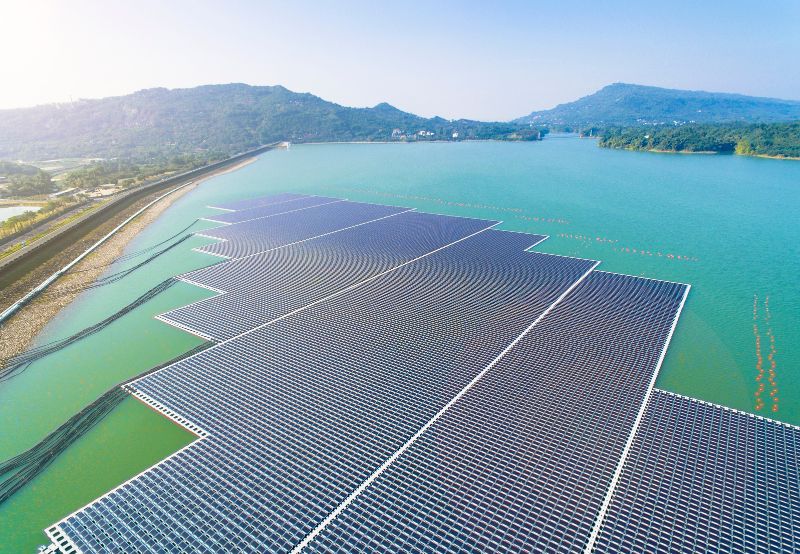
MNRE Tells States to Identify Sites for Floating Solar Project Development

The stakeholder consultation discussed documents prepared by NISE and IIT Roorkee

thumbnail

Follow Mercom India on WhatsApp for exclusive updates on clean energy news and insights


The Ministry of New and Renewable Energy (MNRE) has sought feedback from the states on the draft reports prepared by the National Institute of Solar Energy (NISE) and the Indian Institute of Technology (IIT) Roorkee on the potential of floating solar and the policy framework.

The documents assess India’s floating solar potential and propose a policy framework covering site identification, project execution guidelines, stakeholder roles, approvals, scheduling, and measures to reduce risks for developers and investors.

These reports were prepared to address bottlenecks caused by prevailing land constraints for renewable energy projects, and to promote floating solar as an alternative.

The NISE and IIT reports note that only approximately 700 MW of floating solar projects have been commissioned so far. They also address the lack of data on potential sites and clear frameworks for executing such projects.

The documents were discussed at a recent MNRE stakeholder consultation, which focused on providing solutions, such as plug-and-play models and the allocation of water bodies with all approvals, to derisk developers and investors.

MNRE requested all states and union territories to undertake internal consultations with all state-level stakeholders, including water resources/irrigation, revenue, fisheries, forest, agriculture, public works, tourism, and pollution control departments, as well as the distribution and transmission companies, and provide comments and feedback on the draft policies and floating solar potential.

States and union territories were also asked to identify and prioritize sites for the projects, based on potential and policy.

MNRE said it will also undertake detailed consultations with the Ministry of Environment, Forest and Climate Change, the Wetlands Authority, and the National Dam Safety Authority, among others, on the floating solar policy based on the feedback from the states and union territories.

In an interview on the sidelines of the Mercom India Renewables Summit 2025 held in New Delhi on July 24 and 25, 2025, Deepak Ushadevi, MD and CEO at Ciel et Terre Solar, noted that floating solar is set to become a major driver of India’s renewable energy growth and not just a niche segment offering key advantages over ground-mount systems, such as no land acquisition issues, faster scalability, and higher generation.

Some state governments are recognizing the benefits of floating solar projects and are developing policy frameworks to support their efficient implementation. Last April, the Agency for New and Renewable Energy Research and Technology issued guidelines to support the development of floating solar projects across Kerala.

RELATED POSTS

Get the most relevant India solar and clean energy news.

RECENT POSTS