


DP Cocoa Eyes ₹11 Million Power Bill Savings with Rooftop Solar Project
The 1.2 MW rooftop solar installation is likely to meet 21% of the company’s power needs

Follow Mercom India on WhatsApp for exclusive updates on clean energy news and insights
For energy-intensive industries, the shift to solar is no longer being driven by sustainability targets alone. From food processing units to manufacturing plants, businesses are increasingly adopting captive rooftop solar systems as a practical way to protect margins, stabilize energy costs, and reduce dependence on conventional grid power.
The growing adoption reflects a broader shift in how industries no longer view energy as merely a utility cost but as a strategic business lever.
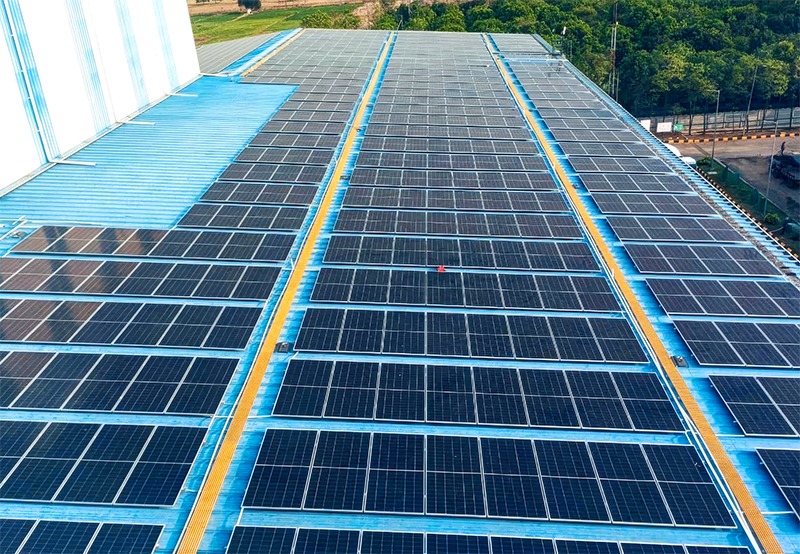
In line with this trend, cocoa and food-processing company DP Cocoa recently commissioned a 1.2-MW rooftop solar project in Chittoor, Andhra Pradesh. The project is expected to reduce the company’s annual electricity expenses by approximately ₹11.2 million (~$117,108).
The company consumes around 8.6 million units of electricity annually. The rooftop solar project is expected to generate approximately 1.79 million units each year, meeting nearly 21% of the company’s annual power requirement.
The project was commissioned recently. Its operational performance and actual electricity bill reductions are yet to be assessed.
The project was executed by Maharashtra-based renewable energy solutions provider Artha Energy Resources. The rooftop system has been installed across multiple roof structures at DP Cocoa’s facility.
The solar installation uses 615 Wp TOPCON bifacial solar modules. Of the total installed capacity, 422 kW has been mounted on reinforced cement concrete (RCC) roofs, while 838 kW has been installed on tin shed structures.
Founder and Managing Partner Animesh Damani said, “The project required a customized system design because the facility had different roof types, varying structural load capacities, and multiple roof orientations. The engineering and execution processes were planned separately for the RCC and tin shed sections to accommodate these technical conditions.”
According to Damani, the project also faced procedural and regulatory challenges during implementation.
“Initially, the client operated with two separate DISCOM connections, which were later merged into a single connection. The merger process took time, delaying the issuance of charging permission for the solar project,” he said.
The company siad that in Andhra Pradesh, coordination processes with government authorities begin only after project installation, rather than running simultaneously with execution, which added to the timeline.
Apart from financial savings, DP Cocoa stated that carbon neutrality was also a factor in the decision to adopt solar power. DP The company is also considering expanding its solar capacity as part of its long-term energy management strategy.
Earlier this year, Artha Energy Resources installed a 1,378.7 kW rooftop solar system for Pidilite Industries.
Mercom India organizes nationwide C&I Clean Energy Meets to bring solar developers and commercial and industrial businesses exploring clean energy adoption onto a common platform.
The next Mercom India C&I Clean Energy Meet event will be held in Hyderabad on August 21, 2026.


Meghana Prasad
More articles from Meghana Prasad.