


Daily News Wrap-Up: India Adds 1.6 GW of Wind Capacity in Q1 2026
CEA proposes a national framework to rationalize DISCOM tariffs
May 18, 2026

Follow Mercom India on WhatsApp for exclusive updates on clean energy news and insights
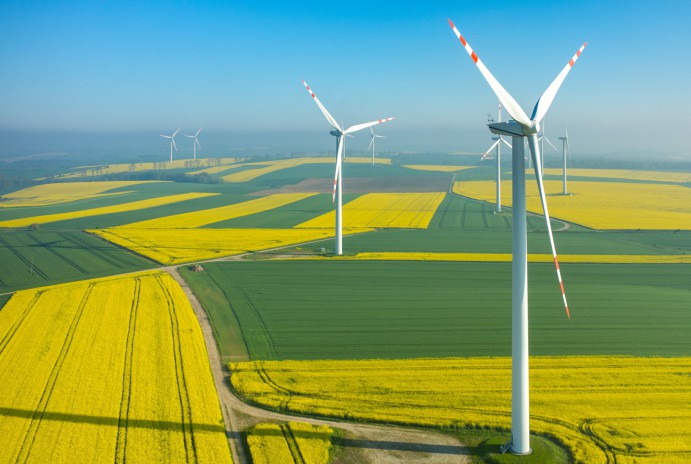
India added nearly 1.6 GW of wind power capacity in the first quarter (Q1) of the calendar year 2026, up 14% quarter-over-quarter from 1.3 GW. The capacity additions fell 16% year-over-year (YoY) from 1.8 GW, according to Mercom India Research. India recorded its highest-ever annual wind capacity addition of 6.3 GW in 2025, an 85% YoY increase from 3.4 GW.
The Central Electricity Authority (CEA) proposed a national framework to rationalize fixed charges and redesign retail tariffs to improve the recovery of fixed costs incurred by distribution companies (DISCOM). The report, titled “Report on Rationalizing Consumer Fixed Charge to Reflect Fixed Costs of DISCOM,” was prepared after deliberations with stakeholders and has been suggested for placement before the Forum of Regulators for implementation.
The Central Electricity Regulatory Commission approved annual transmission charges of ₹23.92 billion (~$249.86 million) for the interstate transmission system project to evacuate 8 GW of power from the renewable energy zone in Khavda, Gujarat, under Phase-V: Part C. The tariff was determined through a bidding process, in which Adani Energy Solutions emerged as the successful bidder.
The Chhattisgarh State Electricity Regulatory Commission proposed a generic levelized tariff of ₹3.40 (~$0.04)/kWh for solar photovoltaic projects between 500 kW and 2 MW and ₹4.95 (~$0.05)/kWh for biogas-based power projects to be commissioned in the financial year (FY) 2026-27. The proposed tariffs are higher than the levelized tariffs of ₹3.39 (~$0.038)/kWh for solar projects in FY 2026 and ₹4.88 (~$0.054)/kWh for biogas projects.
The Punjab State Power Corporation (PSPCL) announced the winners of the 500 MW/1,000 MWh standalone battery energy storage systems (BESS) auction. The tender was floated in January this year. Successful bidders must set up BESS to make stored power available to PSPCL for charging and discharging as needed.
The Solar Energy Corporation of India (SECI) announced the winner of its auction to set up a 10 MW grid-connected solar project in Odisha. The tender was issued in February this year. The project will be developed on a build-own-operate basis. SECI will sign a 25-year power purchase agreement with the selected developer. The power will be sold to GRIDCO on a back-to-back basis.
The Delhi Vidhan Sabha recently commissioned a 500 kW rooftop solar system at a cost of ₹29.4 million (~$307,112). The project was completed within 90 days. The expected return on investment for the rooftop solar system is five to six years.
The Energy Efficiency Services, a government entity under the administrative control of the Ministry of Power, issued an expression of interest for feasibility studies and detailed project reports for ground-mounted, rooftop, and floating solar projects across India. The projects can be developed under capital expenditure, renewable energy service company, or operating expenditure models.
Rooftop solar solutions company Fujiyama Power Systems commissioned a 2,000 MW solar module manufacturing facility in Ratlam, Madhya Pradesh. In addition to solar modules, the facility will manufacture batteries and inverters. The facility is part of Fujiyama’s large-scale greenfield manufacturing expansion project. With this project, the company aims to strengthen its integrated solar manufacturing capabilities.
State-owned lender to the energy sector, Power Finance Corporation, reported consolidated revenue from operations of ₹289.20 billion (~$3.03 billion) in Q4 of FY 2026, down 1.2% YoY from ₹292.65 billion (~$3.06 billion). The company’s consolidated net profit rose 2.9% YoY to ₹85.98 billion (~$899.33 million) from ₹83.58 billion (~$874.26 million).
Government-owned power generation company SJVN’s revenue rose 196.7% to ₹14.96 billion (~$156.31 million) in the fourth quarter of FY 2026 from ₹5.04 billion (~$52.66 million) in the same period last year. Revenue increased due to contributions from newly commissioned solar and thermal assets and the recognition of prior tariff-related income.
Solar module and cell manufacturer Premier Energies posted revenue of ₹22.7 billion (~$237.12 million) in Q4 of FY 2026, up 40.1% YoY from ₹16.2 billion (~$169 million). Higher sales volume of solar modules and cells contributed to the revenue growth.


Mercom Staff
More articles from Mercom Staff.