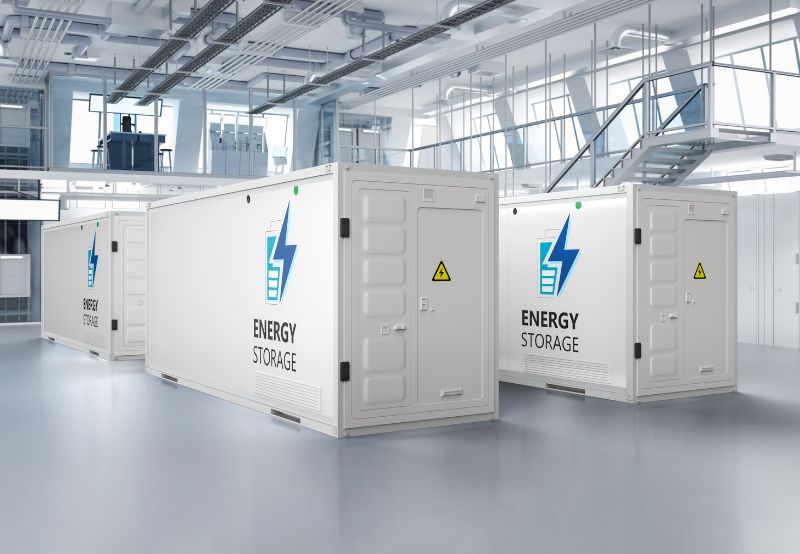
Uttarakhand Invites Bids to Set Up 16 MW/40 MWh BESS in Haridwar
The last date to submit bids is March 5, 2026
February 9, 2026
Follow Mercom India on WhatsApp for exclusive updates on clean energy news and insights
UJVNL, a Government of Uttarakhand undertaking, has floated a tender to set up a 16 MW/40 MWh battery energy storage system (BESS) at the Pathri substation and hydroelectric project in Uttarakhand’s Haridwar district.
The projects will receive viability gap funding support.
Bids must be submitted by March 5, 2026. Bids will be opened on March 7.
The project’s estimated cost is ₹882.4 million (~$9.74 million).
Bidders must furnish an earnest money deposit of ₹8 million (~$88,352.16), a document fee of ₹5,000 (~$55.22) plus 18% GST, and a processing fee of ₹400,000 (~$4,417.61) plus 18% GST.
Selected bidders must submit bank guarantees of ₹20 million (~$220,880) at the rate of ₹1.25 million (~$13,805.02)/MW. They must submit a payment security deposit of ₹500,000 (~$5,522.01)/MWh before the project is commissioned.
Successful bidders must sign a 12-year battery energy storage purchase agreement with UJVN.
Apart from setting up the BESS, the scope of work entails the procurement, installation, testing, maintenance, and operation of the electrical system installed in the project premises. It also involves providing the dedicated transmission network up to the interconnection/delivery point.
Selected bidders must obtain the no-objection certificate/environmental clearance, water usage approval, approval from the Chief Electrical Inspector, and other approvals for the BESS project and its transmission network.
They must ensure a monthly AC-to-AC round-trip efficiency (RtE) of 85%.
Only commercially established and operational technology must be used in the BESS project.
The project must incorporate electrochemical batteries, including lead acid, lithium-ion, solid-state, or flow technologies.
The project must be commissioned within 18 months.
Delays in commissioning the project and failure to meet the RtE and other performance standards will result in liquidated damages.
Bidders must meet any of the following requirements:
- They must be an original equipment manufacturer of containerized BESS, or they must have an Indian manufacturing license agreement with manufacturers who have supplied a cumulative BESS capacity of at least 100 MWh. At least one BESS project must have had a capacity of at least 15 MWh.
- They must have set up a standalone or co-located BESS with at least 20 MWh capacity as an engineering, procurement, and construction (EPC) contractor or a developer
- They must have commissioned renewable energy projects, including solar, wind, and small hydro, with a minimum cumulative capacity of 45 MW as an EPC contractor or developer. These projects must have been operational for at least six months while connected to a minimum 33 kV grid.
- They must have commissioned renewable energy projects, including solar, wind, and small hydro, with a minimum capacity of 15 MW at a single location. These projects must have been operational for at least six months while connected to a minimum 33 kV grid.
- They must have designed, engineered, and constructed a substation from 400 kV to 33 kV voltage level, costing a total of at least ₹250 million (~$2.76 million) in the last seven years. These substations must have been operational for the previous two years.
Bidders must have a minimum net worth of ₹7.4 million (~$81,725.75)/MW of the quoted capacity at the end of the previous financial year or at least seven days before the bid submission deadline.
Bidders must have been profitable in at least one of the preceding three years.
Recently, UJVN floated two tenders to set up 15 MW/37.5 MWh standalone BESS each in the Udham Singh Nagar and Dehradun districts of Uttarakhand. It also invited bids for setting up a 30 MW/75 MWh standalone BESS at the Dhakrani Hydro Electric Project in Dehradun district.