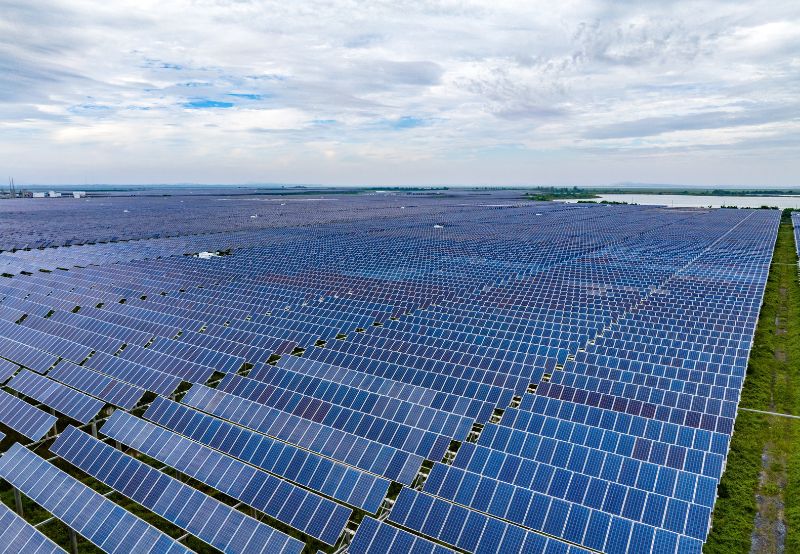
Top Five States for Solar Open Access Installations in 2025

The top five states made up roughly 85% of the total installations

thumbnail

Follow Mercom India on WhatsApp for exclusive updates on clean energy news and insights


India added 7.8 GW of solar open access capacity in 2025, the highest addition recorded in any calendar year, according to the Q4 and Annual 2025 Mercom India Solar Open Access Market report.

Solar open access installations remained steady in 2025, supported by sustained commercial and industrial (C&I) demand for long-term renewable power procurement.

Corporates are increasingly opting for green power procurement to reduce electricity costs and meet sustainability commitments. This sustained demand helped maintain healthy open access project pipelines and support annual installation levels, even as other market segments faced policy and execution-related headwinds.

Karnataka, Maharashtra, Rajasthan, Gujarat, and Tamil Nadu led solar open access installations in 2025, contributing to slightly over 85% of the total.

Ranking of Top States for Solar Open Access

Karnataka

Accounting for 24.5% of the year’s total solar additions, Karnataka emerged as the leading state for open access solar, increasing by 70.3% from the previous year. During the October to December quarter, the state accounted for 16% of India’s total open-access solar installations.

Solar open access installations in Karnataka recorded a marginal increase in 2025, driven by steady C&I demand for decarbonization and cost savings.

However, distribution companies remain hesitant to sign power sale agreements with renewable implementing agencies because seasonal demand patterns do not align with year-round renewable generation. As a result, developers with letters of award but no executed power purchase agreements face uncertainty and are shifting focus toward C&I open access, where demand is relatively stronger. This transition remains challenging because developers must undergo the green energy open access (GEOA) approval process, which adds regulatory complexity and delays.

Maharashtra

Maharashtra was second on the list, accounting for 20.3% of the total capacity additions. The state’s installations increased 11.1% from 2024.

The Maharashtra Electricity Regulatory Commission (MERC) provided greater regulatory clarity in 2025 by reaffirming that consumers can simultaneously pursue rooftop solar and open access under the existing Distributed Open Access framework. Through orders issued in 2025 and early 2026, MERC strengthened consumer rights by directing Maharashtra State Electricity Distribution Company to process net billing agreements and permit the co-existence of net metering alongside open access.

These rulings reduced procedural uncertainty, improved financial predictability, and enabled C&I consumers to structure open access agreements, including hybrid and storage-backed renewable energy projects.

Maharashtra has faced challenges stemming from regulatory uncertainty, which could otherwise have led to even higher installations. Policy changes related to energy banking restrictions, unfavorable time-of-day tariffs, and open access charges have led developers and commercial and industrial consumers to moderate their investment plans.

Rajasthan

Rajasthan ranked third in solar open access capacity additions in 2025, accounting for 18.2% of the total. It registered a 14% YoY increase in capacity additions.

The state’s open access growth is supported by strong irradiation and policy support. The Rajasthan Electricity Regulatory Commission expanded open access eligibility to C&I consumers with 100 kW load, enabled flexible tenures, and introduced storage-linked incentives to improve project viability.

Transmission infrastructure augmentation, including the commissioning of the 765 kV Khetri–Narela line, and an estimated 13 GW of spare capacity for the financial year 2026, has strengthened evacuation readiness and improved confidence in open access growth.

Gujarat  

Gujarat retained its fourth rank among states for solar open access additions in 2025, accounting for 11.6% of the total.

In late 2025, Gujarat unveiled the Integrated Renewable Energy Policy, 2025, consolidating the state’s clean energy objectives under a unified framework. The policy underscores a strong push toward large-scale deployment of renewables, energy storage, and open access.

However, despite supportive policies, recent regulatory changes have tempered near-term attractiveness. The increase in the additional surcharge for open access consumers by ₹0.18 (~$0.002)/kWh, and the continued application of banking charges at ₹1.5 (~$0.016)/kWh, have narrowed developer margins and reduced the cost advantage of open access over grid supply.

Tamil Nadu

Tamil Nadu ranked fifth among leading states in open access in 2025, improving its position from the previous year and accounting for 10.9% of the total capacity additions. Its open access capacity additions increased 16.8% from 2024.

The state’s uptick in solar open access installations was driven by regulatory clarity, sustained C&I demand, and improved policy execution. This growth was also supported by the GEOA Regulations, 2025, which improved regulatory clarity and streamlined approvals. Elevated high-tension tariffs and a large industrial base further accelerated the closure of power purchase agreements and the commissioning of projects, boosting market momentum.

Mercom’s solar open access tracker provides all vital project details for installed and pipeline captive, group captive, third-party, and projects under solar parks in the country. For the complete report, visit: https://www.mercomindia.com/product/q4-2025-mercom-india-solar-open-access-market-report

RELATED POSTS

Get the most relevant India solar and clean energy news.

RECENT POSTS