


TBK India Expands Rooftop Solar Capacity After Strong Phase 1 Returns
The company has now added 274 kW after commissioning 750.2 kW in 2022

Follow Mercom India on WhatsApp for exclusive updates on clean energy news and insights
For automotive component manufacturers, machining, assembly, testing, and other production processes require an uninterrupted, stable electricity supply. Rooftop solar allows such facilities to use available roof space to reduce grid electricity consumption, lower power costs, limit exposure to tariff increases, and reduce emissions associated with manufacturing operations.
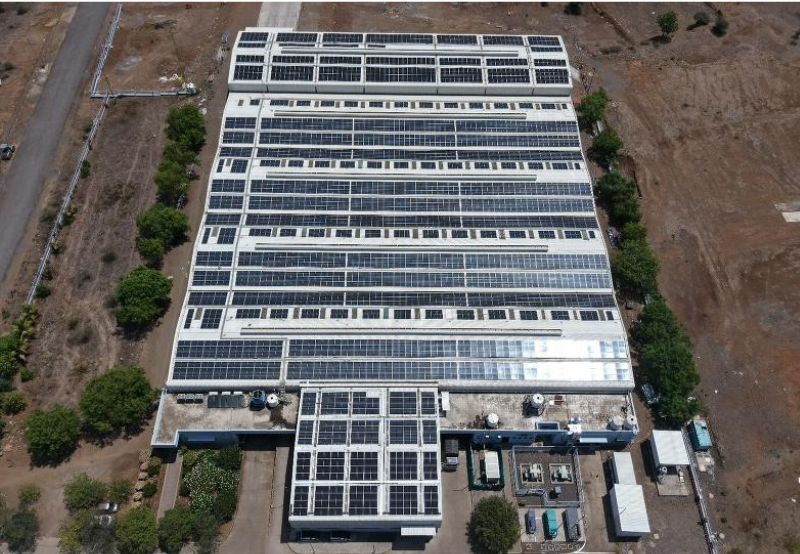
Automotive components manufacturer TBK India had already experienced the benefits of going solar when it commissioned a 750.2 kW rooftop solar project in 2022. It has now expanded the rooftop solar capacity at its facility in Shirval, Khandala, Maharashtra, to 1,024.2 kW.
To optimize operating costs and reduce its environmental footprint, the company has integrated renewable energy into its day-to-day manufacturing operations.
The company manufactures precision mechanical engineering products and automotive components, and water and oil pumps, which it supplies to Indian and international original equipment manufacturers.
TBK India is a wholly owned subsidiary of Japan-based TBK Co.
B.U. Bhandari Energy executed both phases of the project.
According to the installer, the first phase achieved its projected return on investment within the expected timeframe and consistently delivered the anticipated electricity generation and savings. The financial and operational performance of the initial installation prompted TBK India to expand its rooftop solar capacity.
The solar systems operate under net metering, allowing surplus electricity generated at the facility to be exported to the grid and adjusted against electricity consumed from the grid.
The installations use bifacial solar modules from Trina Solar and Novasys, along with Growatt inverters. An E-Senz system is used for monitoring plant performance.
Phase I has generated approximately 3,986.7 MWh of electricity to date, while the recently commissioned second phase has generated about 66.2 MWh.
The combined rooftop solar capacity is estimated to avoid approximately 1,146 metric tons of carbon dioxide emissions annually.
B.U. Bhandari Energy recently installed a 500 kW rooftop solar power project for Pune-based precision transmission components manufacturer JAL Precision Products.
The company earlier installed two rooftop solar systems totaling 705 kW for Pune Polymers, a manufacturer of plastic components, across its manufacturing facilities in Maharashtra.
It also commissioned a 2.5 MW rooftop solar project for textile firm Bombay Dyeing and Manufacturing Company at its Rasayani facility in Maharashtra.
Rooftop solar installations accounted for 18% of India’s total solar installations during Q1 2026, according to Mercom India’s Q1 2026 India Rooftop Solar Market Report.
Mercom India also hosts a pan-India C&I Clean Energy Meet series, bringing renewable energy developers and commercial and industrial power consumers together to discuss clean energy adoption. The next event in the series will be held in Hyderabad on August 21, 2026.


Arjun Joshi
More articles from Arjun Joshi.