Storage Market Could Become Bigger Than Solar and Wind Combined: Interview

Whether it's curtailment, transmission, or 24/7 power, storage is the missing link

thumbnail

Follow Mercom India on WhatsApp for exclusive updates on clean energy news and insights


As renewable energy penetration rises, battery storage is becoming critical for addressing the intermittency of solar and wind, managing curtailment, and supplying firm power to consumers. At the same time, transmission constraints, right-of-way issues, domestic solar cell availability, and project financing timelines continue to affect project development.

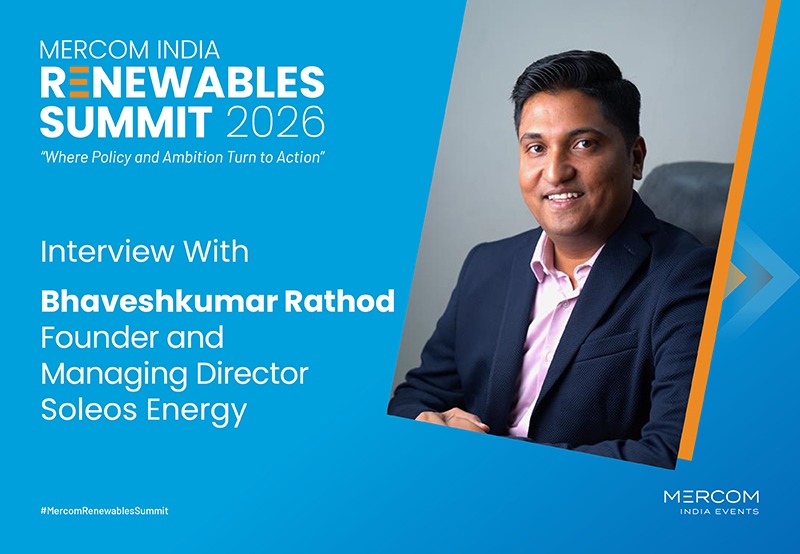
Soleos Energy is an India-based renewable energy company providing end-to-end solutions across utility-scale, commercial and industrial (C&I), rooftop, floating solar, and energy storage projects. On the sidelines of the Mercom India Renewables Summit 2026, Bhavesh Kumar Rathod, Founder and Managing Director at Soleos Energy, spoke about domestic manufacturing, battery energy storage, open access, transmission bottlenecks, financing, and the company’s plans to support industrial decarbonization.

The following are edited excerpts from the interview.

How are developers reassessing project viability amid uncertainty around module prices, domestic content requirements, and other regulatory changes?

The transition from non-DCR to DCR modules within six months was not entirely smooth, although the government had provided sufficient time for the industry to prepare. Developers who had assessed projects using cheaper non-DCR modules found it difficult to accept the higher cost of DCR-compliant modules. There are challenges during the transition, but the market will eventually adjust.

What are the major challenges EPC companies face in the market?

India has around 175 GW to 200 GW of DCR-compliant module manufacturing capacity. However, domestic cell manufacturing capacity is only around 25 GW to 30 GW.

This is also nameplate capacity and does not represent the actual annual output available to the market. The mismatch between module and cell manufacturing capacity is one of the biggest challenges facing EPC companies.

How is the expected implementation of ALMM List-II affecting projects?

Domestic cell capacity remains limited, and ALMM List-II-compliant cells are not abundantly available in the market. Modules containing compliant cells may be available in smaller quantities. However, procuring 200 MW or 300 MW for a large project is currently challenging. The limited availability of cells is therefore affecting procurement planning and project execution.

Storage is being viewed as the next major opportunity alongside solar and wind. What is your view?

Solar and wind are intermittent sources and do not offer complete predictability, while industrial consumers require firm power. Storage provides that firmness.

Whether the problem is curtailment, transmission constraints, or the need for round-the-clock supply, storage has emerged as the common binding element across renewable energy technologies. Several companies are entering storage manufacturing, and Soleos Energy is also developing a large manufacturing facility. The storage market could eventually become larger than the solar and wind markets combined.

Battery storage costs have declined from around $550/kWh to nearly $100/kWh. However, prices have stopped falling over the past year and a half and have increased slightly in some cases. Even at current levels, storage has become commercially viable, and solar-plus-storage has achieved grid parity in several applications.

How do you expect the commercial and industrial (C&I) open access market to develop over the next two to three years?

C&I consumers have adopted renewable energy rapidly. The C&I segment accounts for a significant share of the market and is already mature. Demand remains strong and is expected to continue growing for several years as industrial consumers seek lower electricity costs, predictable tariffs, and decarbonization solutions.

How are developers balancing execution timelines against land acquisition and transmission risks?

Land and transmission availability are major bottlenecks. Land-related challenges can be reduced through government intervention, access to government-owned land, better engagement with landowners, and appropriate compensation.

Transmission is a more difficult challenge. India requires substantially higher investment in transmission infrastructure, and the constraint is unlikely to be fully resolved within the next few years through policy measures alone.

What policy intervention is needed to address the transmission bottleneck?

Power evacuation is a major concern. India does not yet operate as a fully unified market at the distribution level. States function largely as separate systems connected through the interstate transmission network, and policies differ across jurisdictions.

Moving electricity from a renewable project in one state to a consumer in another can be difficult, particularly at lower voltage levels.

In some European markets, even a household with a 50-kW solar project can sell electricity into the market. India needs a similarly transparent and robust framework that enables electricity to move more easily from areas with surplus generation to areas facing deficits. Better connectivity and more uniform market rules could help reduce transmission-related constraints.

What is your assessment of Maharashtra’s time-of-day banking framework?

The policy is directionally positive, although it has created concerns for the industry. Electricity generated during solar hours has a lower value, and the framework effectively encourages developers and consumers to adopt battery storage. However, several implementation orders are still awaited.

The policy could create short-term challenges for developers and consumers, but it may support storage adoption and improve grid management over the longer term.

What regulatory changes would improve renewable project execution?

Connectivity support and right-of-way assistance are the most urgent requirements. Large projects have been delayed because of right-of-way disputes, and even major developers face these challenges.

The government should introduce a clear right-of-way framework that protects landowners while allowing developers to complete transmission infrastructure within reasonable timelines.

Storage should also not be evaluated as a standalone asset. Solar, wind, and storage should be considered together as firm capacity.

The government could also examine market mechanisms such as contracts for difference. Projects selling electricity through exchanges currently face the risk of prices falling to zero, which reduces bankability. Introducing an appropriate floor or revenue-support mechanism could improve lenders’ confidence and strengthen project financing.

Is financing a constraint for renewable energy projects?

The availability of financing is not the biggest problem. The timing of financing, cost of funds, loan tenure, and the suitability of financing structures are more significant concerns.

Lenders often expect rigid take-or-pay arrangements. Financing models need greater flexibility, with lenders viewing themselves as long-term business partners rather than only providers of capital.

A deeper understanding of renewable energy business models would help lenders assess risk more effectively and improve the availability of appropriate financing.

How does Soleos Energy plan to contribute to India’s renewable energy growth?

Soleos Energy has focused on adopting new technologies, entering new markets, and solving challenges faced by industrial consumers.

The company aims to help industries decarbonize through solar, wind, energy storage, and other clean energy solutions. Grid electricity tariffs can rise and fluctuate over time, while contracted renewable energy capacity can provide price visibility for up to 25 years.

Long-term renewable energy contracts allow companies to hedge their electricity costs and improve business sustainability. Soleos Energy plans to continue offering such solutions to industries in India and international markets.

RELATED POSTS

Get the most relevant India solar and clean energy news.

RECENT POSTS