


South Central Railway Eyes Expansion After Gains from 2.5 MW Rooftop Solar
The portfolio is expected to save up to ₹30 million annually

Follow Mercom India on WhatsApp for exclusive updates on clean energy news and insights
Railway stations offer large roof areas across passenger terminals, administrative buildings, and service sheds. By installing rooftop solar systems on these structures, Indian Railways can boost electricity generation close to the point of consumption without requiring additional land.
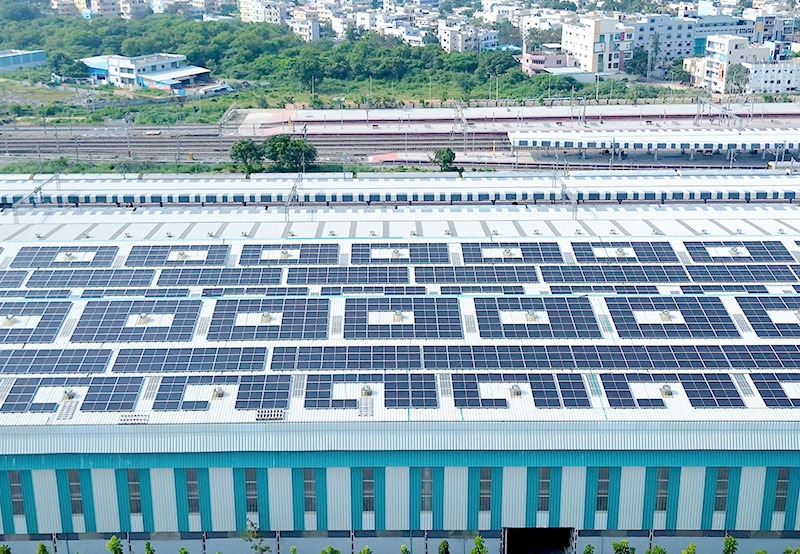
South Central Railway’s (SCR) Secunderabad division has installed rooftop solar systems with a cumulative capacity of 2.5 MW across 30 locations. Encouraged by the savings in power costs, SCR has planned adding capacity across other locations soon.
Hyderabad-based Seven Greens Solar Systems executed the project which was commissioned in phases between March and June 2026.
A 1 MW single-location installation has also been developed at Cherlapally railway station in Telangana.
The 2.5 MW solar project includes 400 kW of building-integrated photovoltaics (BIPV) systems across multiple stations. Unlike conventional rooftop installations, the solar modules form part of the railway station’s roof canopy, providing passengers shelter while generating electricity.
BIPV systems of 100 kW each have been installed on buildings at Manchiryal and Kazipet railway stations. Additionally, 50 kW BIPV systems have been installed at Cherlapally, Lingampet Jagityal, Peddapalli, and Jangaon stations.
With an investment of ₹130 million (~$1.36 million), the rooftop systems are expected to yield estimated electricity cost savings of ₹25 million (~$261,540) to ₹30 million (~$313,848) a year.
On an aggregate basis, the 2.5 MW portfolio offsets approximately 20% of the division’s electrical demand.
According to Seven Greens, around 20 railway stations are expected to reduce their daytime operational electricity costs to net-zero effectively. Some smaller stations can meet 100% of their electricity requirements from solar during daytime peak hours.
The electricity generated from these installations is consumed at the stations for loads such as lighting, signaling systems, administrative operations, and passenger amenities. Surplus electricity is exported to the distribution grid under net metering.
Before the installations, monthly electricity bills at major passenger hubs such as Cherlapally exceeded ₹5 million (~$52,308). Smaller stations and service buildings incurred monthly bills ranging from ₹50,000 (~$523) to ₹200,000 (~$2,092).
The project utilizes 590 W N-type TOPCon bifacial modules supplied by Havells and, Bluebird Solar and Powerone grid-connected inverters ranging from 10 kW to 50 kW.
The projects can generate 3 million to 3.5 million units annually and will provide payback within four to five years. The systems generate an average of approximately 10,000 units a day, with an average specific yield of around 4 kWh/kW/day.
Seven Greens has also secured another 1 MW contract from the SCR’s Secunderabad division to install rooftop systems covering 11 of its railway locations. An additional 1.5 MW capacity is planned over the next six months for secondary railway establishments.
The Seven Greens team has planned another 50-100 kW of BIPV across the stations under this new contract, bringing the total BIPV systems in the Secunderabad division to 500 kW.
According to Mercom India Research’s Q1 2026 India Rooftop Solar Market Report, India added 2.7 GW of rooftop solar capacity in the first quarter of 2026, a YoY growth of 125.4% from 1.2 GW and a 25.4% quarter-over-quarter jump from 2.2 GW.


Melvin Mathew
More articles from Melvin Mathew.