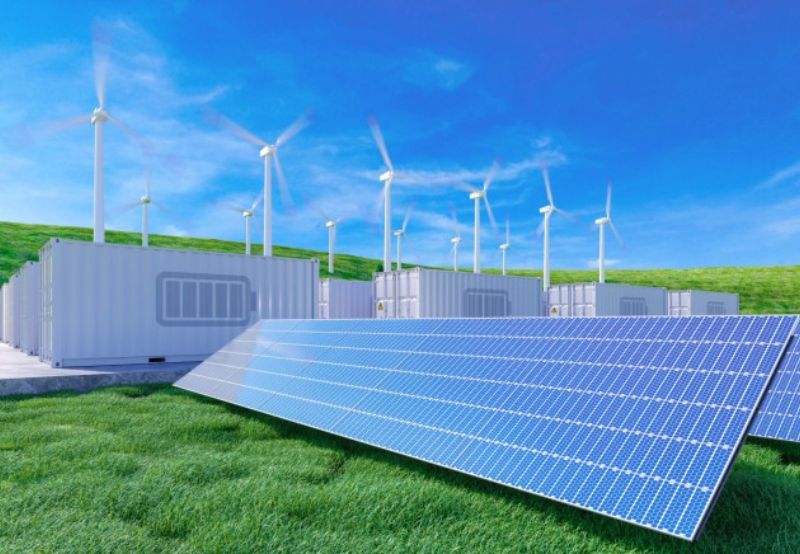
Solar-Wind-Battery Hybrid Systems Can Meet Up to 90% of Electricity Demand
Energy storage can significantly reduce dependence on diesel generators for C&I consumers
May 29, 2026
Follow Mercom India on WhatsApp for exclusive updates on clean energy news and insights
As India’s solar market matures and policies increasingly mandate minimum storage requirements, the commercial and industrial (C&I) sector is steadily shifting toward solar-wind hybrid power projects integrated with battery energy storage systems to meet rising power demand, enable smarter energy dispatch, and support grid stability.
Industry experts estimate that hybrid renewable energy systems combined with storage can offset 85%-90% of a consumer’s total power requirements.
Rajasthan has mandated the integration of battery storage for green open access projects above 5 MW, with storage capacity equivalent to either two hours of generation or 5% of the project’s installed capacity.
Rahul Makahaniya, Chief Marketing Officer at Soleos Energy, said that while standalone solar projects can meet up to 50% of the consumer’s energy needs, and solar-plus-storage can offset up to 70%, integrated solar-wind-storage solutions can meet the majority of power demand.
He added that integrating battery storage into a 20 MW wind-solar project would cost around ₹11 million (~$114,850)/MWh.
Pratibha Sharma, Head of Sales and Marketing (North India) at Ningbo Deye New Energy, said energy storage can significantly reduce dependence on diesel generators for C&I consumers, where power generation costs typically range between ₹30 (~$0.31)/kWh to ₹40 (~$0.42)/kWh. According to Sharma, hybrid renewable systems can deliver payback within three years.
She also noted that storage systems can help offset peak-hour tariffs through demand-based dispatch strategies. Battery storage integrated with power conversion systems enables charging and discharging at optimized intervals, improving operational efficiency and energy management.
Under round-the-clock (RTC) renewable energy models, businesses with continuous power requirements can offset up to 99% of their electricity demand through renewable energy.
Significant Savings Through Rooftop Solar
Renewable energy adoption in the C&I segment is driven by the need to reduce electricity costs, comply with sustainability mandates, and meet supply chain requirements that are increasingly linked to low-carbon operations.
Industry experts noted that net-metered rooftop solar projects can currently offer some of the highest savings potential for businesses pursuing sustainability goals.
Makahaniya emphasized that C&I consumers should maximize rooftop solar installations to the extent feasible and procure the remaining power through open access arrangements.
“Consumers purchasing grid power at around ₹6 (~$0.06)/kWh to ₹7 (~$0.07)/kWh can access rooftop solar power at a levelized cost of around ₹2 (~$0.02)/kWh, resulting in savings of nearly ₹4 (~$0.04)/kWh,” he said.
He added that installing a rooftop solar system of up to 200 kW using DCR-compliant modules would cost between ₹30,000 (~$313)/kW and ₹32,000 (~$334)/kW.
For a 1 MW rooftop solar project, consumers can achieve equity payback within 2.5-4 years, and full project payback within 6 to 8 years.
Rajasthan has imposed a 1 MW capacity limit on net-metered rooftop solar projects to maintain grid stability.
Sharma explained that consumers seeking installations beyond the 1 MW threshold can deploy smaller 100–200 kW hybrid inverters configured as zero-export systems, which also support peak shaving and solar charging of battery storage systems.
She added that businesses experiencing seasonal increases in power demand can integrate diesel generators with hybrid inverters, enabling additional power procurement within the same infrastructure.
Savings Through Green Energy Open Access
Makahaniya said businesses procuring renewable energy through captive open access can achieve savings of nearly ₹4 (~$0.04)/kWh, with project payback periods of less than two years.
Under the third-party open access model, consumers typically realize lower savings, ranging from ₹0.8 (~$0.008)/kWh to ₹1 (~$0.01)/kWh, due to additional cross-subsidy surcharges and related charges. However, this model does not require upfront capital investment.
According to Makahaniya, the group captive model currently offers the greatest savings potential and is particularly suitable for consumers seeking to procure renewable energy while minimizing capital expenditure.
He emphasized that businesses should choose the most suitable open access model based on their investment appetite and operational requirements.
The advantages of rooftop solar and green energy open access procurement for C&I consumers were discussed at Mercom India’s C&I Clean Energy Meet in Jodhpur.
Mercom India will host the sixth edition of the Mercom India Renewables Summit 2026 on July 1-2, 2026, at the Hyatt Regency, New Delhi. The Summit will bring together key stakeholders from across the renewable energy sector for discussions backed by Mercom’s proprietary research and market intelligence. You can register for the event here.