


Solar Plus Storage Cuts Grid Imports and Diesel Use at Maharashtra Firm
Monthly grid imports fell by 20 MWh, while diesel consumption dropped by up to 50 liters from 1,000 liters
August 13, 2026

Follow Mercom India on WhatsApp for exclusive updates on clean energy news and insights
A manufacturing facility in Maharashtra has reduced its monthly grid electricity purchases by 11.1% and lowered diesel consumption after integrating a 600 kW/1.2 MWh battery energy storage system (BESS) with its existing 500 kW rooftop solar installation.
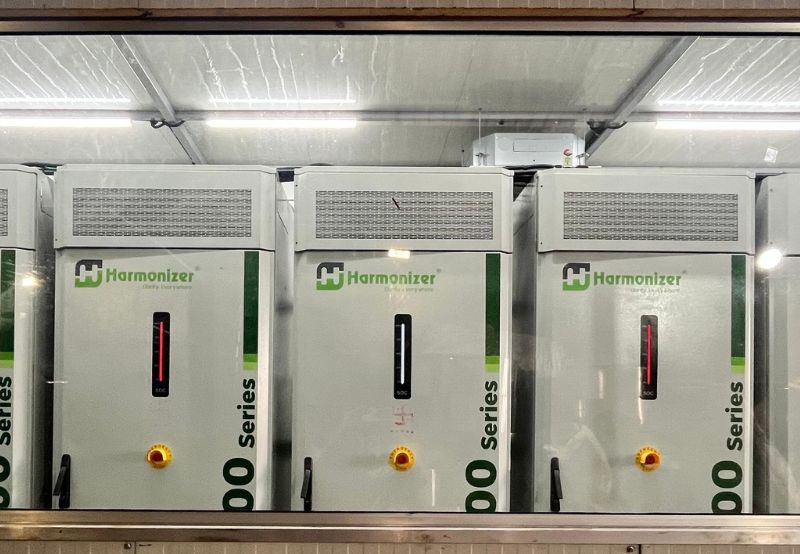
The BESS project at Western Metal Industries’ facility in Pune integrates rooftop solar, battery storage, grid supply, and diesel generation through an energy management system (EMS) developed by Harmonizer Energy.
The two-hour battery system stores excess solar generation, discharges stored energy during higher-tariff periods, provides backup during grid outages, and reduces dependence on diesel generation.
Since commissioning the EMS and BESS, the facility’s monthly grid imports have declined 11.1% from approximately 180 MWh to 160 MWh.
At an average electricity tariff of ₹10.2 (~$0.107)/kWh, this corresponds to approximately ₹204,000 (~$2,139) per month in grid energy cost savings.
The facility reduced its diesel consumption from approximately 400 to 1,000 liters per month before the installation to approximately 50 to 100 liters per month after the BESS was commissioned.
With diesel selling at over ₹90 (~$0.94)/liter, Harmonizer estimates savings of approximately ₹31,500 (~$330) to ₹81,000 (~$849) per month.
BESS Reduces Production Disruptions
Before the BESS was installed, unexpected grid outages frequently interrupted production at the manufacturing facility, resulting in estimated production losses of approximately ₹50,000 (~$524) to ₹60,000 (~$629) per day.
With the BESS providing backup power during grid failures, Harmonizer said these interruptions have been nearly eliminated, helping ensure continuous plant operation and improving production reliability.
The BESS is also used to optimize the utilization of electricity generated by the existing rooftop solar system.
Approximately 22 MWh of electricity is shifted through the battery every month. The BESS charges with excess solar generation and discharges during high-tariff periods, reducing purchases of expensive peak-hour grid electricity.
Solar Gets First Priority
The EMS continuously monitors parameters such as solar generation, load demand, battery state of charge (SOC), grid availability, and time-of-day (ToD) tariff settings.
Solar generation receives the highest priority and supplies the facility’s load first. Excess solar generation is used to charge the BESS until the battery is fully charged.
Once the battery is fully charged, the remaining solar electricity is exported to the grid.
The BESS discharges when the facility’s load exceeds a configured demand threshold for peak shaving or during a grid outage.
During a grid outage, the BESS immediately supports the load. If the battery SOC falls below a configured threshold, the EMS automatically starts the diesel generator and transfers the load. When the diesel generator is running, the photovoltaic system is switched off.
Battery SOC limits, demand thresholds, diesel generator start-and-stop conditions, and ToD schedules can be configured through the EMS.
Integrating BESS With Existing Infrastructure
The project involved integrating the BESS with the facility’s existing 500 kW rooftop solar system, diesel generator, and 11 kV high-voltage grid connection, while ensuring an uninterrupted power supply and stable operations.
A key technical challenge was developing and validating the EMS control logic governing the operation of the rooftop solar system, the grid, the BESS, and the diesel generator.
The project also required seamless transitions between grid-connected and island modes during grid failures.
Reliable communication had to be established between the EMS, power conversion system, battery management system, photovoltaic inverter, energy meters, and diesel generator controller.
The integration included peak shaving based on configurable demand thresholds and coordination between the photovoltaic system, BESS, and diesel generator to ensure that the photovoltaic system is switched off when the diesel generator is operating.
Commissioning and functional testing covered multiple operating scenarios, including grid failures, battery charging and discharging, diesel generator starts and stops, protection interlocks, and restoration to regular operations.
Mercom India hosts a pan-India C&I Clean Energy Meet series, bringing renewable energy developers and commercial and industrial power consumers together to discuss clean energy adoption. The next event in the series will be held in Hyderabad on August 21, 2026.


Arjun Joshi
More articles from Arjun Joshi.