


Solar Corporate Funding Rises 45% to $25 Billion in 9M 2026
Solar project acquisitions rose to 34.4 GW, while venture capital funding declined 31%
November 6, 2026


Follow Mercom India on WhatsApp for exclusive updates on clean energy news and insights
Global solar corporate funding, including venture capital (VC), public market, and debt financing, increased 45% year-over-year (YoY) to $25.1 billion in the first nine months (9M) of 2026 from $17.3 billion in the corresponding period of 2025, according to Mercom Capital Group’s latest 9M and Q3 2026 Solar Funding and M&A Report.
Corporate funding deals rose 35% to 172, up from 127 in the same period last year.
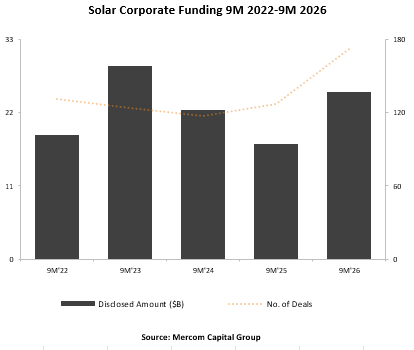 The growth was primarily driven by debt financing, which increased 61% year-over-year (YoY), while public market financing rose 59%. However, VC funding declined 31%. Debt drove nearly all of the net increase in funding, underscoring the importance of corporate borrowing, acquisition financing, and refinancing in the period.
In the third quarter (Q3) of 2026, solar corporate funding totaled $8.2 billion across 77 deals, compared to $6.5 billion across 49 deals in Q3 2025.
Debt financing accounted for the largest share of quarterly funding, with $7.2 billion raised across 36 deals.
“Solar corporate funding increased sharply in the first nine months of 2026, driven largely by debt financing. Public-market fundraising also improved, while both corporate M&A and solar project acquisitions increased as companies expanded their portfolios, recycled capital, and consolidated their operations,” said Raj Prabhu, CEO of Mercom Capital Group.
“Despite the higher activity, financing conditions remained challenging. Changes in U.S. tax policies, trade restrictions, rising equipment costs, and uncertainty over project economics complicated investment decisions. Capital remained available, but access to financing and investor appetite remained uneven across the industry,” he added.
Prabhu said that growing electricity demand continues to support investment in solar. In the U.S., tax credit deadlines also accelerated financing and construction decisions. “However, the increase in funding should not be interpreted as an improvement in financing conditions across the board. Large transactions contributed significantly to the growth, while policy uncertainty, higher equipment costs, and concerns over project economics continued to influence investment decisions.”
Venture Capital Funding
Solar VC funding declined 31% to approximately $2 billion across 60 deals in 9M 2026, compared with $2.9 billion across 55 deals in 9M 2025.
Although VC deal activity increased, the average deal size declined 37% to $33.1 million from $52.9 million. The decline reflected smaller funding rounds and more selective investment, particularly in capital-intensive businesses without established revenue streams.
“Investors have become more selective, focusing on companies with established businesses, stronger financials, and clearer paths to profitability. Downstream companies continued to dominate VC funding, with project developers accounting for nearly half of the total. Indian companies also attracted the most VC funding during the period. The numbers suggest that investors remain interested in solar but are being more cautious about how much capital they commit,” noted Prabhu.
Solar downstream companies accounted for the largest share of VC funding, raising $1.3 billion across 39 deals.
The largest VC funding deal during the period was Inox Clean Energy’s $343 million fundraise, followed by Nexamp at $180 million, Clean Max Enviro Energy Solutions at $165 million, Amarenco at $150 million, and Erco at $129 million.
India attracted about 49% of total solar VC/PE funding, while U.S. companies recorded the most transactions.
A total of 192 VC investors participated in solar funding deals during the first nine months of 2026.
Public Market Financing
Solar public-market financing increased 59% to $2.7 billion across 32 deals in 9M 2026, compared with $1.7 billion across 12 deals in 9M 2025.
IPOs accounted for approximately 49% of public-market financing, with 10 offerings raising about $1.3 billion. India accounted for six IPOs during the period.
Announced solar debt financing increased 61% to $20.4 billion across 80 deals in 9M 2026, compared with $12.7 billion across 60 deals in 9M 2025.
Debt accounted for approximately 81% of solar corporate funding. Project developers accounted for about 59% of debt funding, while manufacturing and equipment companies accounted for about 21%. Borrowing supported corporate credit facilities, acquisitions, refinancing, working capital, and domestic manufacturing investments.
Prabhu noted that solar is a capital-intensive business, and debt financing is essential to supporting its growth. The increase reflects developers’ and manufacturers’ substantial financing needs as they expand operations, acquire assets, and refinance existing obligations.
“Manufacturing accounted for a significantly larger share of debt financing this year, reflecting increased investment in production capacity. Developers also continued to raise substantial amounts to support their project pipelines,” he added.
Securitization activity moved in the opposite direction. Six securitization deals totaling $1.2 billion were recorded in 9M 2026, down 61% from $3.1 billion across seven deals in 9M 2025.
 Mergers and Acquisitions
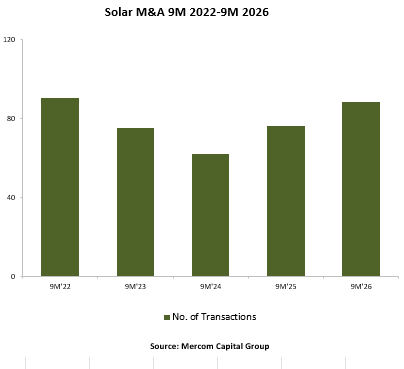
Solar corporate mergers and acquisitions (M&A) increased 16% to 88 transactions in 9M 2026 from 76 in 9M 2025.
Downstream businesses accounted for approximately 66% of corporate M&A, led by acquisitions of project developers and installers. Activity reflected portfolio expansion, strategic acquisitions, and consolidation across the solar value chain.
On mergers and acquisitions, Prabhu said, companies are acquiring businesses to expand geographically, strengthen their capabilities, and gain access to established development pipelines. Financially stressed companies are also selling assets and businesses to improve liquidity or restructure operations.
“On the project side, capital recycling remains an important factor. Developers are selling assets to release capital for new investments. Approximately 62% of acquired project capacity was in the pre-construction stage, which shows that buyers are actively targeting development pipelines rather than just operating projects. Grid access, permitting progress, and the ability to bring projects online are important factors in these acquisitions,” he opined.
In Q3 2026, 31 corporate M&A transactions were announced, compared to 26 in Q3 2025.
The largest corporate M&A transaction during 9M involved INOX Solar Americas, a U.S.-based renewable energy company backed by INOX Clean Energy.
The company signed an agreement to acquire 100% of the assets of Boviet Solar Technology’s U.S. subsidiary, Boviet Solar Technology (North Carolina), for approximately $750 million.
Solar Project Acquisitions
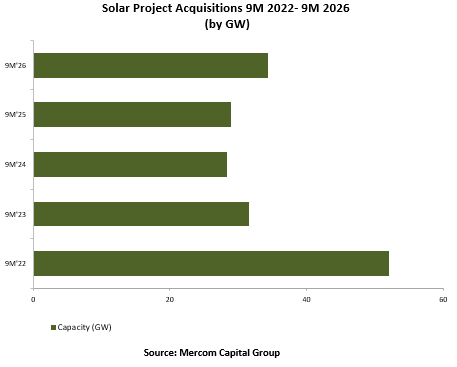
Solar project acquisitions increased in 9M 2026, with 205 transactions totaling 34.4 GW, compared with 166 transactions totaling 29 GW in 9M 2025.
Acquired capacity increased 19% YoY, while the number of transactions rose 24%.
Pre-construction projects accounted for approximately 62% of acquired capacity, indicating continued interest in development pipelines. Rising construction costs, policy uncertainty, and financing constraints also increased the importance of permitting, interconnection progress, and realistic commissioning schedules in acquisition decisions.
In Q3, 71 solar project acquisitions totaling 9.2 GW were recorded, compared to 60 acquisitions totaling 9.1 GW in the same period last year.
Project developers and independent power producers (IPPs) were the most active acquirers during the quarter, acquiring 6.7 GW of solar projects.
Investment firms followed with acquisitions totaling 1.2 GW.
Other buyers, including distributors and engineering and construction companies, acquired 852 MW, while utilities acquired 362 MW.
Going forward, Prabhu noted that debt financing will continue to play a major role in solar funding in 2027, particularly for established developers and manufacturers. VC funding is likely to remain selective.
“M&A activity should remain active as companies look to expand, consolidate operations, and recycle capital. Growing electricity demand will continue to support investment, but U.S. tax policies, trade restrictions, equipment costs, and interest rates will have a significant influence on funding decisions. Solar demand is not the issue. The challenge is developing projects that make financial sense under changing market and policy conditions,” he observed.
This report covers 528 companies and investors. It is 77 pages long and contains 68 charts and tables.
To learn more about the report, visit: https://mercomcapital.com/product/9m-q3-2026-solar-funding-ma-report


Rakesh Ranjan
More articles from Rakesh Ranjan.