


Solar and Wind Additions Push Global Renewable Energy Capacity to 5.2 TW
Renewables accounted for nearly half of global installed power capacity in 2025
August 11, 2026

Follow Mercom India on WhatsApp for exclusive updates on clean energy news and insights
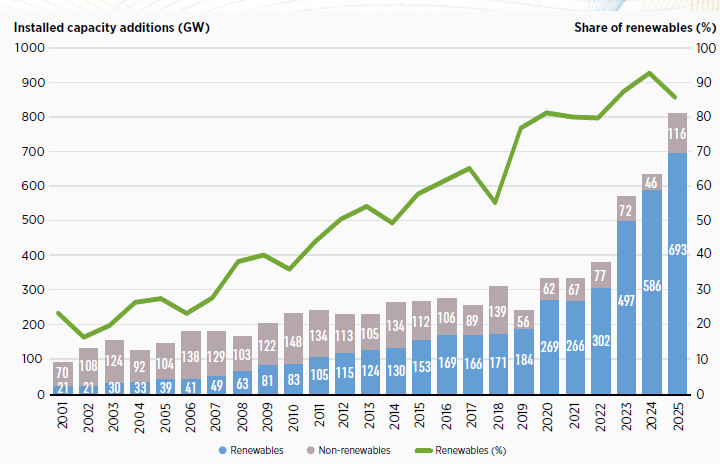
Global renewable energy capacity reached 5,155 GW at the end of 2025, following annual additions of 693 GW, taking renewables’ share of global installed power capacity to 49.5%, according to the International Renewable Energy Agency (IRENA).
In the Renewable Energy Highlights 2026 report, IRENA stated that renewable capacity grew 15.1% year over year, exceeding the average annual growth rate of 11.9% recorded from 2019 to 2024. Variable renewable energy sources, comprising solar and wind, increased by 22.3% during the year and accounted for 35.4% of total global installed power capacity.
Renewable sources represented 85.7% of all power generation capacity additions in 2025, down from 92.7% in 2024.
However, the report attributed the decline in renewables’ share of annual additions to a rebound in non-renewable capacity, driven primarily by China’s addition of 83 GW of coal-fired capacity.
IRENA noted that the total installed renewable capacity worldwide reached 10.41 TW at the end of 2025, with renewables accounting for 5.2 TW and non-renewable sources making up the remaining 5.3 TW. Non-renewable capacity comprised 4.6 TW of fossil fuel generation, 407 GW of nuclear power, 160 GW of pumped storage, and 58.7 GW of other non-renewable sources.
Solar and Wind Continue to Dominate
Solar remained the world’s largest renewable energy technology with an installed capacity of 2,397 GW, representing 46.5% of global renewable capacity. Hydropower followed with 1,296 GW, accounting for 25.1%, while wind reached 1,291 GW, or 25% of the total renewable installed capacity. Bioenergy capacity stood at 155 GW, geothermal at 16 GW, and marine energy contributed a small share of installed capacity.
Solar and wind continued to dominate new renewable installations. Solar capacity increased by 514 GW during 2025, while wind added 158 GW. Together, the two technologies accounted for 96.9% of all net renewable capacity additions during the year. Annual renewable capacity additions reached a record 693 GW, continuing a trend of accelerating deployment over the past two decades.
Despite the record additions, IRENA said deployment remains concentrated to a limited number of regions. Asia accounted for 74.1% of global renewable capacity additions, increasing installed renewable capacity by 514.1 GW in 2025. Europe added 77.4 GW, while North America installed 42 GW. South America added 19.7 GW, followed by the Middle East with 12.8 GW, Africa with 11.3 GW, Eurasia with 8.4 GW, Oceania with 6.1 GW, and Central America and the Caribbean with 1.8 GW.
Electricity Generation by Source
The report also highlighted the continued growth in renewable electricity generation. Renewable sources generated 9,836 TWh of electricity in 2024, accounting for 31.7% of global electricity generation. Total electricity generation reached 30,995 TWh during the year, with fossil fuels, nuclear energy, pumped storage, and other non-renewable sources accounting for the remaining 68.3%. Renewable electricity generation increased 9.8% from 2023, while non-renewable generation grew by 1.4%.
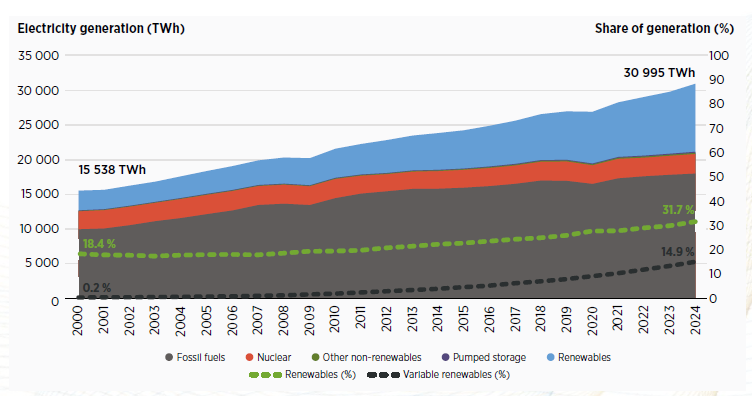
Renewable electricity generation expanded at a compound annual growth rate of 6.3% from 2014 to 2024, compared to 1.3% for non-renewable sources. Variable renewable energy generated 4,606 TWh of power in 2024, representing 46.8% of renewable electricity generation and 14.9% of global electricity generation. Solar and wind together accounted for more than half of the increase in renewable electricity generation during the year, with generation expanding by 16.8% from 2023 levels.
Hydropower remained the largest renewable electricity source, generating 4,472 TWh in 2024, an increase of 197 TWh from the previous year. Wind generation reached 2,499 TWh after growing 8.5%, while solar generation increased 28.6% year over year to 2,106 TWh, the fastest annual growth rate since 2018. Bioenergy generated 660 TWh, geothermal contributed 98 TWh, and marine energy generated nearly 1 TWh.
Renewable Energy Generation by Region
Asia remained the largest region for renewable electricity generation, producing 4,589 TWh in 2024, up 14.3% from the previous year. Europe generated 1,758 TWh, followed by North America with 1,535 TWh and South America with 1,047 TWh. Eurasia produced 411 TWh, Africa generated 227 TWh, Oceania produced 138 TWh, the Middle East generated 76 TWh, and Central America and the Caribbean generated 55 TWh. The Middle East recorded the highest regional growth rate in renewable electricity generation at 17.3%.
South America recorded the highest share of renewables in its electricity mix, with renewables accounting for 77.2% of generation, primarily from hydropower. Europe followed at 48.8%, supported by a diversified mix of hydropower, wind, solar, bioenergy, and geothermal energy.
Oceania generated 41.3% of its electricity from renewable sources, while Central America and the Caribbean reached 35%, Africa 29%, Asia 28.6%, North America 27.4%, Eurasia 25.3%, and the Middle East 5.1%.
The report noted that both the Group of Seven and the Group of Twenty economies continued to generate more electricity from non-renewable than renewable sources in 2024. Renewable energy accounted for 30.7% of electricity generation in both groups. Within the G20, hydropower accounted for 41.6% of renewable electricity generation.
IRENA said achieving the renewable energy target adopted at the 28th United Nations Climate Change Conference requires significant acceleration in deployment. The global target calls for renewable power capacity to exceed 11.17 TW by 2030. With installed renewable capacity reaching 5.15 TW at the end of 2025, approximately 6.02 TW of additional renewable capacity must be deployed over the remainder of the decade.
The report also highlighted slower progress in renewable heat generation. Renewable sources accounted for 6.2% of global commercial heat generation in 2024, totaling 933 petajoules. Bioenergy supplied 90.1% of renewable heat generation, while geothermal and solar thermal energy accounted for most of the remainder. Europe generated nearly 90% of global renewable heat and accounted for 30.5% of regional heat generation.
According to a recently published report by IRENA, installed renewable energy capacity helped curb fossil fuel costs by an estimated $480 billion in 2025, as the cost advantage between clean energy and conventional energy continues to widen.
Earlier, IRENA proposed removing or reducing tariff and non-tariff barriers on imported renewable energy equipment in the short term, amid growing disruptions in fuel markets due to the Middle East crisis.


Rakesh Ranjan
More articles from Rakesh Ranjan.