R&D Key to Next Phase of India’s Solar Growth, Global Competitiveness
Panelists emphasized the need to invest in upstream integration, automation
July 10, 2026
Follow Mercom India on WhatsApp for exclusive updates on clean energy news and insights
India’s solar manufacturing industry has rapidly expanded over the past few years, driven by supportive government policies and growing domestic demand. However, industry leaders believe the next phase of growth will depend less on adding manufacturing capacity and more on investing in research and development (R&D), automation, upstream integration, and advanced technologies to compete globally.
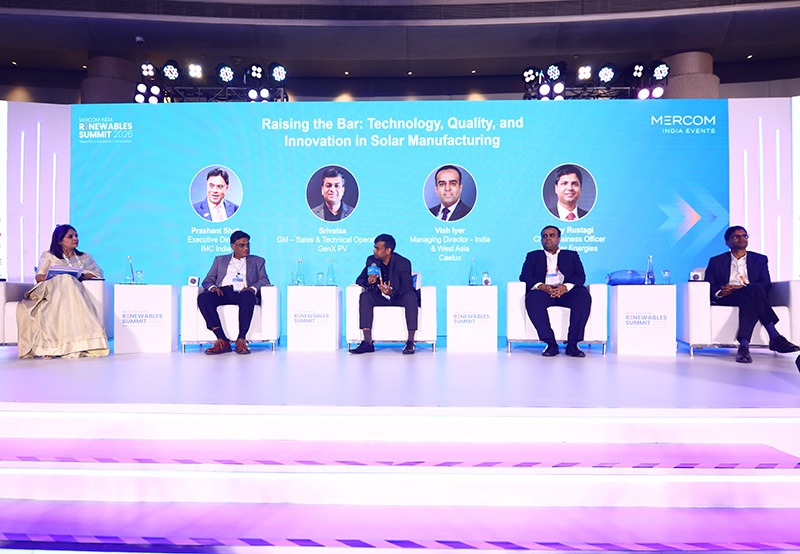
Panelists at a discussion titled “Raising the Bar: Technology, Quality, and Innovation in Solar Manufacturing” at the Mercom India Renewables Summit 2026, called for policy support for the ancillary industry on the lines of the Approved List of Models and Manufacturers mandate for solar cells and modules.
Moderator Priya Sanjay, Managing Director at Mercom India, said the country’s manufacturing landscape has undergone a rapid transformation over the last few years. She highlighted that monocrystalline modules have displaced polycrystalline technology, while TOPCon has emerged as the dominant technology in new module manufacturing. India’s announced solar cell manufacturing pipeline for 2026 is nearly 11 times the capacity added in 2025, reflecting the industry’s rapid expansion.
India Must Move Beyond Following Technology Trends
Industry experts said that India’s solar manufacturing industry is still relatively young from a technology perspective, making companies reluctant to take risks on emerging technologies.
Prashant Shah, Executive Director at International Marketing Corporation (IMC), said that in India, the industry adopts technologies only after they have matured elsewhere.
He noted that the industry has largely converged on TOPCon today, paying little attention to technologies beyond it. He stressed the need for upstream integration in the solar manufacturing sector.
Vinay Rustagi, Chief Business Officer at Premier Energies, said manufacturing technology cycles have shortened considerably, with major transitions now occurring every three to five years.
He emphasized that solar manufacturers investing heavily in TOPCon today must already evaluate future transitions to back-contact cells and, eventually, to tandem perovskites. Companies must continuously assess technology compatibility, upgrade pathways, and future investment requirements before committing capital.
The panelists, however, cautioned that technological breakthroughs often take decades to become commercially viable.
Rustagi noted that perovskites, for example, have been under development for over 20 years but have yet to achieve widespread commercial deployment. Similarly, HJT adoption has been slower than expected because of higher capital costs and operational complexity.
Tandem Technologies
About emerging technologies, Vish Iyer, Managing Director (India and West Asia) at Caelux, said tandem perovskite technology represents the first major technological shift beyond conventional silicon-based improvements.
Caelux’s technology modifies the top glass layer of existing modules with a coating rather than replacing entire manufacturing lines. The company specializes in perovskite thin-film technology.
The approach, he said, could significantly improve power output while extending the useful life of existing manufacturing investments.
He added that the technology could improve module power ratings by around 30%, increase energy yield by 15% to 20%, and reduce the levelized cost of electricity.
Iyer attributed the development of tandem technology to significant government-backed investments in Japan, South Korea, and the U.S.
India must rethink how emerging technologies move from laboratories to commercial deployment. Current policy frameworks, he said, remain focused on incremental improvements within silicon technologies and do not adequately support experimental technologies.
He suggested creating institutions similar to Germany’s Fraunhofer Institutes or the U.S. National Renewable Energy Laboratory, where industry and government jointly commercialize promising technologies.
He noted that India also needs clearer pathways to allow limited deployment of experimental technologies before commercial-scale manufacturing begins.
Iyer said the Caelux’s technology is also compatible with mono PERC, TOPCon, and HJT manufacturing lines, allowing manufacturers to extend production line lifecycles from roughly four or five years to six or eight years, rather than investing in entirely new production facilities.
Upstream Localization
As India’s solar manufacturing moves beyond modules and cells into upstream manufacturing, speakers said the next challenge is to move upstream into ingot and wafer manufacturing.
Rustagi noted that domestic module demand has increased sharply, growing nearly 90% last year and about 50% the year before. Annual module demand currently stands at around 60 GW and could approach 100 GW by the end of the decade.
To support that demand, he said that India would require approximately 80 GW of ingot and wafer manufacturing capacity, representing investments of nearly ₹$500 billion (`$5.3 billion) over the next three years.
While Rustagi believes that capital itself is no longer a primary constraint for the solar manufacturing sector, he said that access to technology, operational knowhow, and the development of a domestic supply chain for consumables such as pullers, graphite rods, and crucibles remain the industry’s biggest hurdles.
Rustagi also pointed to China’s potential restrictions on technology exports as an emerging challenge, adding that manufacturers would need to collaborate closely with both the government and international technology partners to ensure continued access to advanced manufacturing technologies.
Equipment Quality
While Indian manufacturers are import-dependent for manufacturing equipment, there is always concern about differences in quality.
Shah said that even though India procures from the same equipment suppliers, the quality differs as Indian manufacturers often purchase lower-tier equipment. Pricing remains the primary consideration for Indian manufacturers during procurement.
He also noted that Indian manufacturers frequently omit in-line process inspection and quality-monitoring equipment to reduce costs.
Chinese manufacturers don’t buy turnkey lines and cherry-pick the best equipment for each stage of manufacturing, increasing their production efficiency.
Shah also claimed that Indian companies have often received previous-generation equipment marketed as new.
Speakers argued that India’s manufacturing quality gap will persist unless companies significantly increase R&D investment and adopt technologies ahead of market transitions, rather than merely expanding existing production lines.
Apart from equipment quality, Shah said that automation can play a vital role in improving yield and consistency, and in reducing operational errors, in the manufacturing sector.
Indian manufacturers are gradually adopting similar technologies, including automated guided vehicles and centralized equipment control systems capable of simultaneously operating dozens of manufacturing tools.
However, he noted that India still has a long way to go, but automation adoption is gradually rising across domestic manufacturing facilities.
India is Competitive
Speakers noted that Indian manufacturers often underestimate their global competitiveness because comparisons are almost always made against China.
Rustagi said many Indian manufacturers are already exporting while benchmarking their manufacturing costs, yields, and quality against international competitors.
He claimed that Premier Energies’ manufacturing facilities currently operate at 80% to 90% utilization, whereas many European and American facilities struggle to exceed 50%.
According to Rustagi, many international manufacturers are increasingly looking toward India for manufacturing partnerships because of the country’s growing operational expertise.
ALMM for Ancillary Market
Speakers said that India has expanded its junction box manufacturing capacity by nearly ten to twelve times, substantially reducing import dependence.
Apart from growing capacity, Srivatsa, GM of Sales & Technical Operations at GenX PV, added that procurement teams increasingly recognize the advantages of domestic sourcing, including shorter lead times, lower foreign exchange exposure, and compliance with mandatory BIS certification requirements.
However, he said ancillary manufacturers still require policy support, similar to the Approved List of Models and Manufacturers (ALMM), to accelerate localization further.
Srivatsa added that the missing piece is policy support, similar to ALMM, for ancillary manufacturers, which will permanently shift procurement toward domestic suppliers and help the ecosystem grow.
He emphasized that junction boxes continue to receive insufficient attention, despite being among the most critical components affecting module reliability.
Although junction boxes represent a very small share of overall project costs, he added that failures can result in losses running into crores of rupees.
Srivatsa said GenX PV invests continuously in R&D, reliability testing, safety testing, and inspection procedures to ensure junction boxes perform reliably throughout a module’s expected 30-year operating life.
He stressed that R&D, precise manufacturing, and rigorous testing are essential for the junction box manufacturing segment.