


Pralhad Joshi Calls for Promoting Circular Economy in Renewable Energy Sector
At the Mercom India Renewables Summit, the Minister lauded India’s achievements in the clean energy sector
July 2, 2026

Follow Mercom India on WhatsApp for exclusive updates on clean energy news and insights
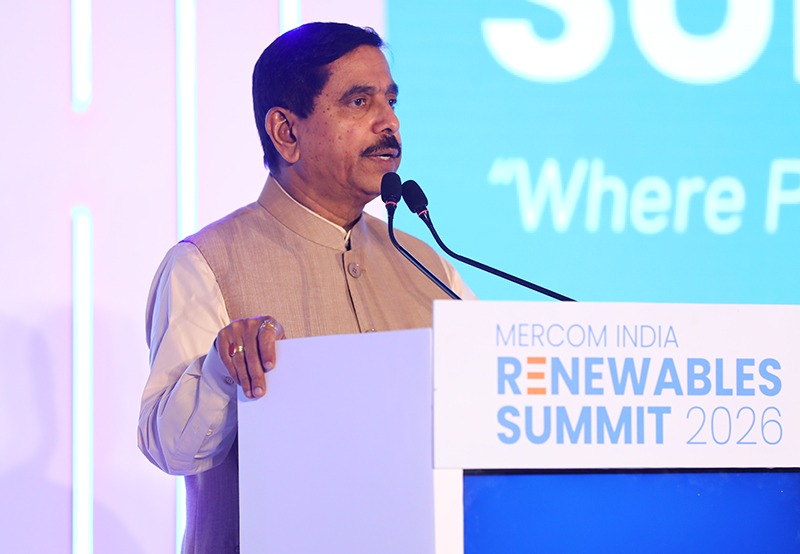
Union Minister for New and Renewable Energy (MNRE) Pralhad Joshi has emphasized the importance of India developing a circular economy for clean energy technologies during his address at the Mercom India Renewables Summit 2026.
He said solar modules, batteries, and other clean energy components must be designed for reuse and recycling.
The Minister suggested that Mercom India introduce a Renewable Circular Economy Award to recognize organizations working in solar module recycling, battery recycling, circular manufacturing, and resource recovery.
Joshi also proposed developing a Renewable Readiness Index to benchmark states and distribution companies based on renewable integration, rooftop solar adoption, metering efficiency, grid readiness, and distribution infrastructure.
He also called for stronger distribution networks and suggested recognizing high-performing DISCOMs and districts that effectively integrate renewable energy.
Highlighting India’s rapid progress in renewable energy deployment and manufacturing amid increasing infusion of investment, he said there must be stronger focus on quality, energy storage, wind repowering, and a circular economy.
Joshi said India has emerged as the world’s third-largest renewable energy market by installed capacity, surpassing several major economies, including Brazil and Germany. He noted that the country added 37 GW of solar capacity in 2025, making it the second-largest solar growth market globally, ahead of the U.S. in annual solar additions.
He said the investment momentum has also accelerated significantly, with renewable energy deal values increasing from $378 million in 2024 to $2 billion in 2025, positioning India among the world’s most attractive clean energy investment destinations.
India’s renewable energy sector also attracted $23 billion in foreign investment between April 2022 and June 2025, supported by competitive deployment costs, expanding domestic manufacturing, stable policy support, and improved access to financing.
Share of Renewables Grows
Joshi said renewable electricity generation increased by nearly 24% in 2025, while electricity generation from coal and natural gas declined by 3.7% year-over-year to 1,230.19 TWh.
He noted that the rising share of renewables in the power mix demonstrates that economic growth, energy security, and clean energy expansion can progress together.
India’s non-fossil fuel capacity has increased to more than 290 GW, with solar alone accounting for 156 GW, and wind capacity comprising 56.4 GW.
Joshi noted the need to repower aging wind turbines to increase generation from existing wind sites. “I have asked stakeholders to study the issue and submit a report within a month. If policy changes are required, we are open to considering them.”
He highlighted that India is building a complete domestic renewable energy manufacturing ecosystem, reducing dependence on imports. “While many countries focus only on adding capacity, India has chosen a more sustainable path. We are building a complete renewable energy ecosystem within the country.”
Rising Domestic Reliance
The Minister also highlighted India’s manufacturing progress, noting that solar module manufacturing capacity has expanded to 200 GW, while solar cell manufacturing has reached 30 GW.
According to Joshi, imports of solar photovoltaic modules declined 54% to $994 million last year.
The Minister also spoke about the rapid progress in energy storage, with 94 battery energy storage system projects totaling approximately 30 GW/88 GWh are operational or nearing commissioning.
He noted that the Central Electricity Authority estimates India will require approximately 60 GWh of storage capacity by 2030, making storage one of the country’s highest infrastructure priorities.
Joshi also emphasized that rapid deployment must be accompanied by stringent quality standards. He said the government is strengthening the Bureau of Indian Standards’ requirements while implementing additional quality-control orders covering solar modules and batteries.
The growth of the renewable energy sector must be supported by a strong investment in research and development (R&D). The Minister drew attention to the ongoing research by institutions such as the IITs and IISc on tandem solar cells, perovskites, and advanced battery technologies.
Joshi also commended Mercom India for introducing new awards recognizing R&D, noting that the categories were added following his suggestion at last year’s Summit.
On grid planning, Joshi said Phase I of the national GIS mapping exercise across eight renewable-rich states has identified 345 GW of renewable energy potential for future grid integration, with subsequent phases already underway.
Discussing the National Green Hydrogen Mission, he said the ₹200 billion (~$2.11 billion) program aims to produce 5 million metric tons of green hydrogen and its derivatives annually by 2030 while accelerating domestic manufacturing and offtake agreements. India has already achieved a record-low price discovery for green hydrogen projects.
“India’s clean energy journey is about building a complete industrial ecosystem across manufacturing, innovation, storage, transmission, financing, skilled manpower, and global competitiveness. This is the foundation of Make in India and an energy-atmanirbhar (self-reliant) India.”


Melvin Mathew
More articles from Melvin Mathew.