


Over 16% of New US Utility-Scale Solar Co-Located with Battery Storage in 2026
The share of new solar capacity co-located with battery storage could exceed 30% in 2027 and 2028
November 5, 2026

Follow Mercom India on WhatsApp for exclusive updates on clean energy news and insights
More than 16% of the utility-scale solar capacity added in the U.S. through September 2026 was co-located with operational battery energy storage systems, compared to just 2% in 2017, according to the U.S. Energy Information Administration (EIA).
The share is projected to increase to 19% by the end of 2026, based on developers’ reported plans for solar projects scheduled to become operational during the final three months of the year.
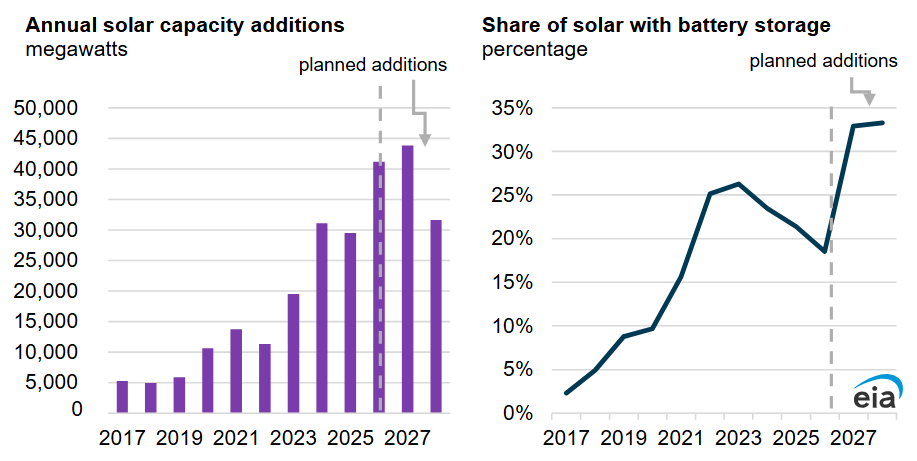
The EIA expects the trend to continue, with more than 30% of planned utility-scale solar capacity additions in both 2027 and 2028 expected to be co-located with battery storage.
As battery storage becomes more integrated with solar projects, developers can manage generation and dispatch based on prevailing wholesale electricity prices.
In regions with high solar penetration, wholesale electricity prices typically decline during periods of strong solar generation and increase as solar output falls.
Co-located battery storage lets developers store electricity when solar generation is high and dispatch it to the grid when prices are more favorable, improving the economic value of their projects.
According to the EIA, solar and battery storage facilities at the same project site often begin commercial operations at different times. The agency tracks these developments through its annual and monthly electric generator reporting programs.
As of September 2026, solar power projects accounted for 13% of the total U.S. utility-scale electricity generating capacity. Of this solar capacity, 18% was co-located with battery storage.
The southwestern states, which have relatively high solar penetration, also reported greater adoption of co-located battery storage.
California, Arizona, New Mexico, and Nevada recorded shares of solar capacity paired with battery storage that were more than double the national average.
California and Texas recorded estimated wholesale electricity cost savings of $2.5 billion and $3.55 billion, respectively, between June and August 2026 compared with the corresponding period in 2021. The decline in wholesale electricity prices was partly attributed to increased solar generation and battery energy storage deployment.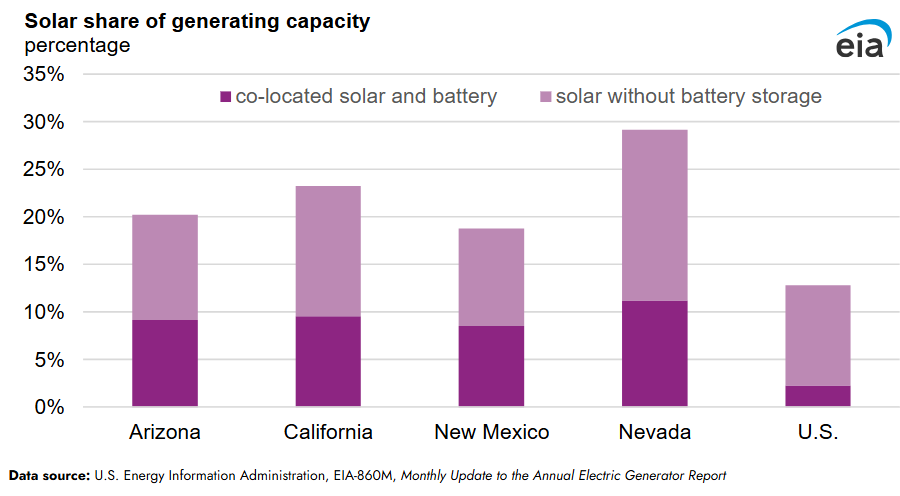
The EIA’s findings show that battery storage is fast becoming an integral component of utility-scale solar development in the U.S., allowing project operators to respond to changing electricity market conditions and optimize the value of solar generation.
According to another EIA report, utility-scale solar is the fastest-growing energy source in the U.S., expected to increase to 424 billion kWh by 2027, up from 290 billion kWh in 2025. The country’s electric power generation reached 4,620 billion kWh in 2025 and is projected to grow by 1.1% in 2026 and 2.6% in 2027.


Rakesh Ranjan
More articles from Rakesh Ranjan.