


Mercom Calls for 1,000 GW 10-Year Solar Roadmap to Support India’s Energy Transition
India must avoid repeating the boom-and-bust cycles seen in other solar markets
July 2, 2026

Follow Mercom India on WhatsApp for exclusive updates on clean energy news and insights
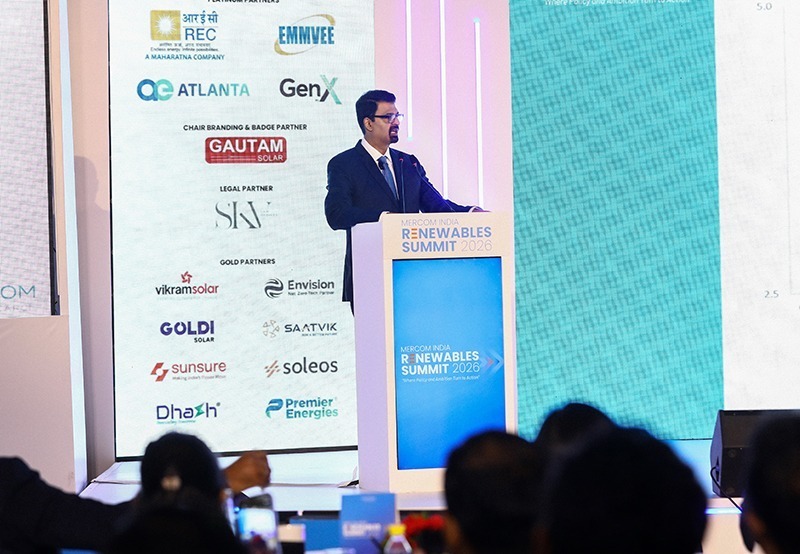
India must set enhanced solar energy targets to provide long-term demand visibility for manufacturers, developers, investors, and financiers, and to support infrastructure development, transmission rollout, and resource planning, Raj Prabhu, CEO of Mercom Capital Group, said at the Mercom India Renewables Summit 2026.
In his keynote address, Prabhu said Mercom recommends that the government set targets of 100 GW for the flagship rooftop solar program, the PM Surya Ghar: Muft Bijli Yojana, and 100 GW for solar open access, and extend the PM-KUSUM program. “This would encourage continued investment across the value chain,” he said.
Calling for long-term certainty, he said India should consider setting a 10-year national solar target of 750-1,000 GW. This would require annual installations of around 75-100 GW and provide the visibility needed to attract domestic and foreign investment and, more importantly, absorb the domestic module, cell and other manufacturing capacities being built up in the country.
About India’s solar manufacturing, Prabhu said India has successfully built one of the world’s largest solar manufacturing ecosystems outside China. Module manufacturing capacity continues to expand rapidly, supported by government initiatives and private investment. Additional capacity is expected to come online through 2026 and 2027. However, this has created a module overcapacity situation currently, leading to consolidation and potentially causing some manufacturers to go out of business.
“However, cells are a completely different story; we are beginning to see significant shortages in domestic solar cells,” he added.
“Based on our analysis, this supply gap is likely to remain a challenge throughout 2026 and into the first half of 2027,” Prabhu noted.
Scaling advanced solar cell production requires time. New production lines must stabilize, improve yields, qualify products, and establish reliable commercial operations before they can consistently serve the market.
Prabhu noted that a significant portion of newly commissioned capacity will be consumed internally by vertically integrated manufacturers, reducing availability for independent developers.
“These realities remind us that installed manufacturing capacity and market-ready supply are not the same thing. The transition toward domestic cell manufacturing was necessary. Perhaps it happened 6-9 months faster than the supply chain was ready for. A more gradual transition could have reduced today’s bottlenecks,” he said.
India must avoid repeating the boom-and-bust cycles seen in other solar markets. China experienced several phases of overcapacity and consolidation over the past two decades, with many large companies exiting the market. Its government responded by creating demand-side programs to absorb manufacturing capacity and support deployment.
Prabhu said a larger renewable energy market will be essential to meet future electricity demand. Emerging demand centers such as artificial intelligence, data centers, electric mobility, and industrial electrification will require vast amounts of clean, reliable power.
Prabhu emphasized that creating new demand centers will be critical to sustaining India’s renewable energy growth. He noted that a 6% year-over-year increase in electricity demand will not be sufficient to accommodate the planned scale of solar capacity, making electrification across the transportation, industry, and power sectors a key priority.
“Emerging demand from artificial intelligence and data centers could further accelerate renewable deployment, particularly through solar-plus-storage solutions that can be deployed faster than conventional power sources,” Prabhu noted.
For India, which lacks abundant fossil fuel resources, expanding electrification, with renewables at the center, is essential to strengthening energy independence and security.
As India enters the next phase of its clean energy journey, maintaining momentum will require more than ambitious capacity additions. A balanced approach that aligns manufacturing expansion with sustained demand, stable policy frameworks, and long-term investment certainty will be critical to avoiding supply constraints and market volatility.
By setting bold post-2030 renewable energy targets, expanding demand through new government programs, and strengthening the domestic supply chain, India can build a resilient clean energy ecosystem that not only meets its climate commitments but also enhances energy security and establishes the country as a global leader in the renewable energy transition.


Rakesh Ranjan
More articles from Rakesh Ranjan.