Madhya Pradesh Offers Diverse Solar Solutions for C&I Consumers
Battery storage solutions can boost savings for high nighttime power users
Follow Mercom India on WhatsApp for exclusive updates on clean energy news and insights
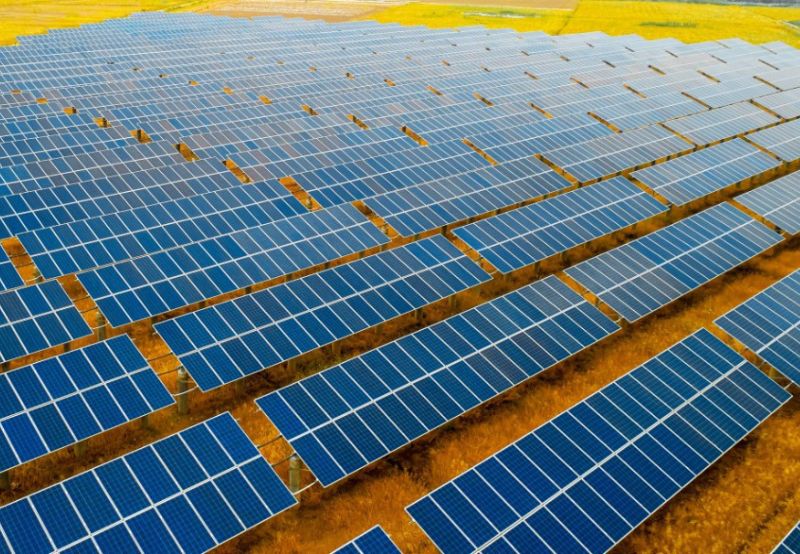
Commercial and industrial (C&I) consumers in Madhya Pradesh have access to a wide range of renewable energy solutions, including rooftop solar, open access, and hybrid models.
According to industry experts, solar solutions can be tailored to nearly every consumer profile, depending on factors such as power demand, capital availability, and infrastructure constraints.
Open Access
As of December 2025, Madhya Pradesh was the eighth-largest state in open access solar, accounting for about 4% of the installations in India.
The state has a robust pipeline, with 77% of projects being standalone solar and 23% wind-solar hybrid power projects.
The process of setting up an open access project typically begins with assessing electricity consumption and load profiles, followed by selecting an appropriate procurement model among captive, group captive, or third-party models, before seeking regulatory approvals.
Approvals for open access projects in the state can take up to two-and-a-half months, after which project development can proceed.
Under open access, group captive models are increasingly preferred for long-term savings. Projects under these models offer greater tariff visibility than short-term third-party agreements, which may be prone to more frequent policy changes.
In Madhya Pradesh, open access tariffs range between ₹3.6 (~$0.038)/kWh and ₹4.5 (~$0.048)/kWh, and it is typically recommended for consumers with a minimum monthly consumption of 500,000 units.
Under the captive open access model, businesses can procure power at approximately ₹3.7 (~$0.039)/kWh, resulting in savings of around ₹4 (~$0.042)/kWh. Third-party models offer lower savings of about ₹1 (~$0.011)/kWh to ₹1.1 (~$0.012)/kWh but require no upfront capital investment.
Group captive models offer savings in the range of ₹2.5 (~$0.027)/kWh to ₹3 (~$0.032)/kWh.
Despite the savings, open access projects incur operations and maintenance costs that typically range from ₹350,000 (~$4,200)/MW to ₹500,000 (~$6,000)/MW annually, depending on project size.
Since setting up open access projects requires significant capital expenditure (CAPEX), financing remains a key concern for businesses transitioning to renewables.
For rooftop solar systems, experts recommend CAPEX models due to quick payback periods of around three years.
Rahul Makhaniya, Chief Marketing Officer at Soleos Solar Energy, said that with the state grid tariff of ₹8 (~$0.086)/kWh, consumers can save around ₹6 (~$0.064)/kWh under the net-metered rooftop solar model.
However, for smaller enterprises with limited capital, industry experts say alternative financing structures, such as zero-upfront-investment and collateral-backed funding, are emerging.
Battery Storage Boosts Savings
Battery energy storage can be a game-changer for commercial consumers with high nighttime power demand and for businesses planning to replace diesel generators.
According to Makhaniya, battery solutions are currently viable for commercial establishments, such as hotels, for which grid tariffs of around ₹15 (~$0.159)/kWh or higher apply. By storing electricity during the day and using it at night, businesses can reduce costs to about ₹8 (~$0.085)/kWh, generating savings of up to 50%.
He added that businesses replacing diesel generators can expect savings of 40%-50%. Diesel generation costs typically range from ₹19 (~$0.201)/kWh to ₹30 (~$0.318)/kWh, while integrating battery storage can bring costs down to ₹11 (~$0.117)/kWh–₹12 (~$0.127)/kWh.
However, experts say that battery storage solutions are not yet economically viable for most industrial consumers due to high battery costs and lower DISCOM tariffs.
Explaining the economics, Sheshagiri Meka, Chief Executive Officer at Winsol Green Solutions, said, including the initial investment and the operational expenses, the landed costs of battery storage systems are around ₹7 (~$0.074)/kWh, while solar-plus-storage solutions cost approximately ₹10 (~$0.106)/kWh.
At these price levels, Meka noted that battery storage remains unviable for industrial consumers, with tariffs typically ranging between ₹7 (~$0.074)/kWh and ₹8 (~$0.085)/kWh across India.
Experts also highlighted that the shift to clean energy is not driven solely by cost savings. Export-oriented businesses, particularly in states like Madhya Pradesh, face increasing pressure to adopt sustainable practices to remain part of global supply chains.
Makhaniya noted that sectors such as cement are required to source 35%–40% of their power from renewable energy, making compliance a key driver.
Contract Demand Limitations
Industry experts note that, due to contract demand limitations in Madhya Pradesh, businesses are increasingly turning to wind-solar hybrid power projects to meet a larger share of their energy needs.
Rooftop solar systems remain highly feasible for businesses in the state with monthly power consumption below 200,000 units, despite the state’s contract demand limitations.
Meka said that in Madhya Pradesh, for a business with a 1,000 KVA contract demand, solar open access can meet only 30%-35% of the power requirements. However, wind-solar hybrid solutions can increase this share to 55%–60%.
He added that wind-solar hybrid solutions are better suited to consumers with monthly power consumption exceeding 1–1.5 million units, while standalone solar open-access projects are better suited to those consuming over 500,000 units monthly.
Solar projects are typically sized between 500 kW and 1 MW, while wind projects use turbines of around 3.3 MW capacity, capable of generating approximately 10 million units annually, with output concentrated in specific seasons.
Wind-solar hybrid power can be procured at tariffs ranging between ₹5 (~$0.053)/kWh and ₹5.2 (~$0.055)/kWh.
These insights were part of the discussions at Mercom India’s C&I Clean Energy Meet held in Bhopal.
The next edition of the event will be held in Mumbai on April 16, 2026.
Contact us if you plan to install solar and need guidance or vendor recommendations.