


India’s Transmission Pipeline Sufficient for 2035 Renewable Growth, Execution Key
Nearly 45% of the identified transmission coverage is still planned or under planning
October 8, 2026

Follow Mercom India on WhatsApp for exclusive updates on clean energy news and insights
India’s transmission infrastructure comprised approximately 509,603 circuit kilometers (ckm) of transmission lines and 1,478 gigavolt-amperes (GVA) of transformation capacity as of June 2026, according to Mercom India Research’s newly released State of Transmission Infrastructure in India report.
India’s transmission network has grown significantly over the past decade, with transmission line length increasing by 50.8% and transformation capacity more than doubling, rising 111.7% between April 2016 and June 2026.
Despite this expansion, transmission infrastructure remains unevenly distributed across the country, with constraints becoming increasingly evident in regions with high renewable energy penetration, the report notes.
Execution Remains Key
The Central Electricity Authority’s transmission planning for FY36 covers infrastructure for approximately 16% more capacity than projected renewable capacity under the base case. The report, therefore, does not anticipate a nationwide transmission infrastructure shortage. Instead, execution and location-specific readiness are expected to become the primary challenges.
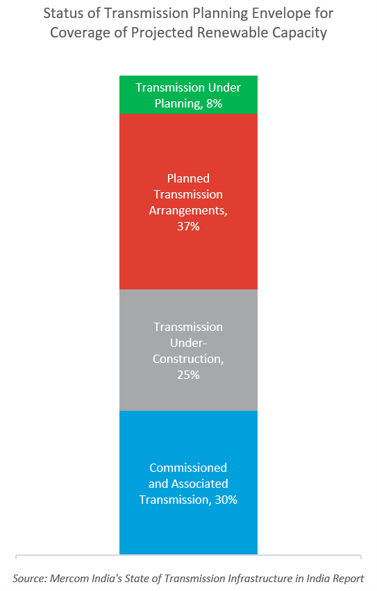
India has identified enough transmission infrastructure on paper to support the projected renewable build-out, but almost 45% of the FY36 planning envelope is still only planned or under planning. .
“Transmission bottlenecks are increasingly concentrated in specific renewable regions and at critical points in the evacuation chain. A project can be ready, and the interstate corridor can be available, but if a pooling station, transformer, bay, or state network is delayed, the project still cannot inject power. With almost 45% of the FY36 transmission requirement still planned or under planning, transmission development needs to keep pace with renewable projects in the regions where capacity is being added,” said Raj Prabhu, CEO, Mercom India.
India’s total installed generation capacity is projected to reach approximately 811 GW by FY31 and 1,121 GW by FY36. Renewable energy capacity is expected to increase to approximately 501 GW and 786 GW, respectively.
The transmission network will consequently have to accommodate significantly larger power flows, particularly from regions with high renewable concentration.
Transmission Requirements for Renewables
Integrating 500 GW of non-fossil generation by 2030 is expected to require approximately 51,000 ckm of additional interstate transmission lines and 434 GVA of transformation capacity. India’s interregional transfer capability is projected to increase to approximately 150 GW.
For solar and wind integration between FY27 and FY36, approximately 137,500 ckm of interstate and intrastate transmission lines and 828 GVA of transformation capacity will be required.
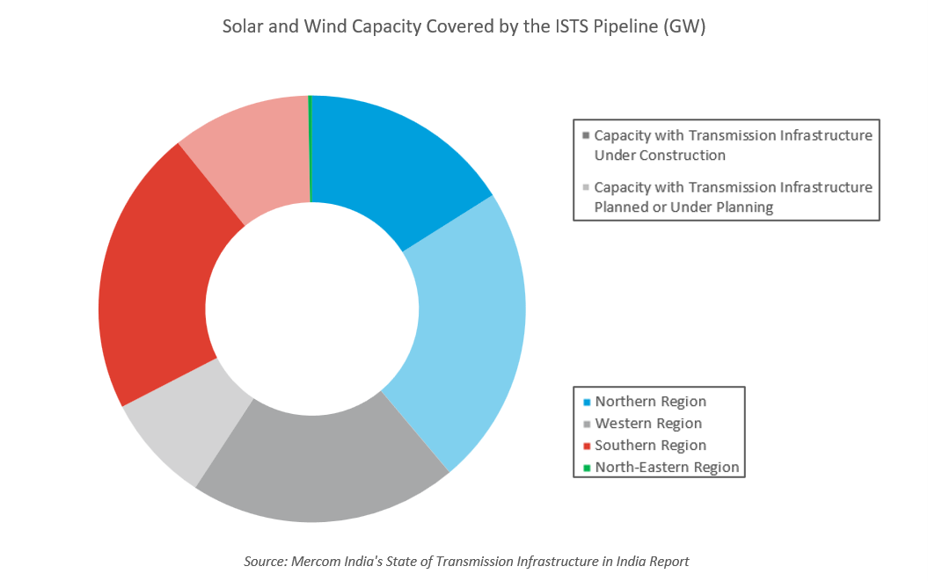
A substantial part of the required infrastructure has already entered the development pipeline. More than 56,000 ckm of transmission lines and 338 GVA of transformation capacity were under construction through FY30. The broader planned pipeline identified more than 102,000 ckm and 891 GVA through FY35.
Green Energy Corridors
The government and transmission agencies are also expanding infrastructure specifically intended for renewable energy evacuation. Green Energy Corridor (GEC) Phase I and Phase II have together commissioned approximately 10,254 ckm of transmission lines and 29,020 MVA of transformation capacity as of June 2026.
GEC Phase III, approved in September 2026, is designed to integrate up to 135 GW of renewable energy capacity and includes 50 GWh of battery energy storage. The program has a total approved outlay of approximately ₹1.86 trillion (~$19.43 billion).
Private Participation
Transmission expansion is also increasing opportunities for private developers. Between April 2025 and June 2026, 116 transmission tenders were issued, comprising 78 interstate and 37 intrastate transmission projects. During the same period, 35 transmission projects were awarded through competitive bidding, with POWERGRID securing 13 projects.
The continued use of tariff-based competitive bidding is widening participation in the sector and moving more identified transmission requirements toward implementation.
Big Investment Opportunity
India’s identified transmission investment requirement through 2035 could exceed ₹15 trillion (~$155.61 billion), according to Mercom. Renewable energy integration alone is estimated to require approximately ₹10 trillion (~$103.74 billion).
The expansion is expected to drive demand for transmission lines, pooling stations, substations, transformers, reactors, gas-insulated switchgear (GIS), high-capacity conductors, high-voltage direct current (HVDC) equipment, static synchronous compensators (STATCOMs), protection systems, and digital substations. However, developing multiple projects simultaneously could strain equipment supply chains, particularly for components with long manufacturing lead times or high import dependence.
Solar and wind projects can typically be developed faster than major high-voltage transmission systems, creating a risk that generation capacity is commissioned before the associated evacuation infrastructure is available. The reverse can also occur, with transmission infrastructure becoming operational before the corresponding generation projects are commissioned.
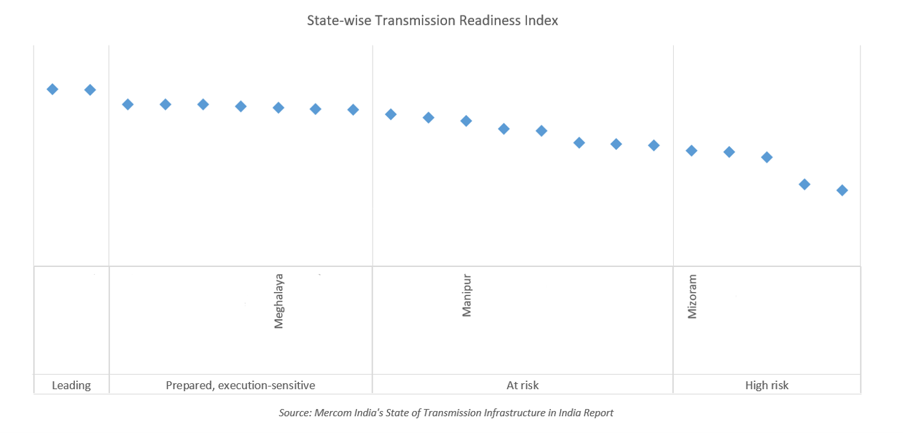
“Transmission readiness has to be evaluated at the project and state level, not just by national line length or transformation capacity. More than half of India’s high-voltage network is within the states, and delays in intrastate infrastructure can hold up projects even when interstate capacity is available. Our Mercom India Transmission Readiness Index shows significant differences across states and highlights where large renewable pipelines are most exposed to transmission and grid-strengthening delays. As renewable capacity continues to grow, transmission investment has to be directed to the locations and critical nodes where the bottlenecks actually exist,” added Prabhu.
State-wise Transmission Readiness
Transmission readiness also varies significantly across states. According to Mercom’s State-wise Transmission Readiness Index, only two states fall in the leading category, while Mizoram and four others are classified as high-risk. Rajasthan, Gujarat, and several other states with substantial renewable energy installations face very high conditional curtailment exposure if critical transmission infrastructure and grid-strengthening projects are delayed.
Mercom India’s State of Transmission Infrastructure in India report assesses the existing transmission network, projects under construction and planned infrastructure, transmission tenders and auctions, renewable energy corridors, state-level network readiness and risks, investment requirements, project bankability, equipment and supply-chain opportunities, regulatory priorities, and India’s transmission roadmap through 2030 and 2035.
For the complete report, visit: https://www.mercomindia.com/product/state-transmission-infrastructure-india


Rakesh Ranjan
More articles from Rakesh Ranjan.