


India’s Solar Growth Exposes Industry-Wide Talent Readiness Gap: Mercom
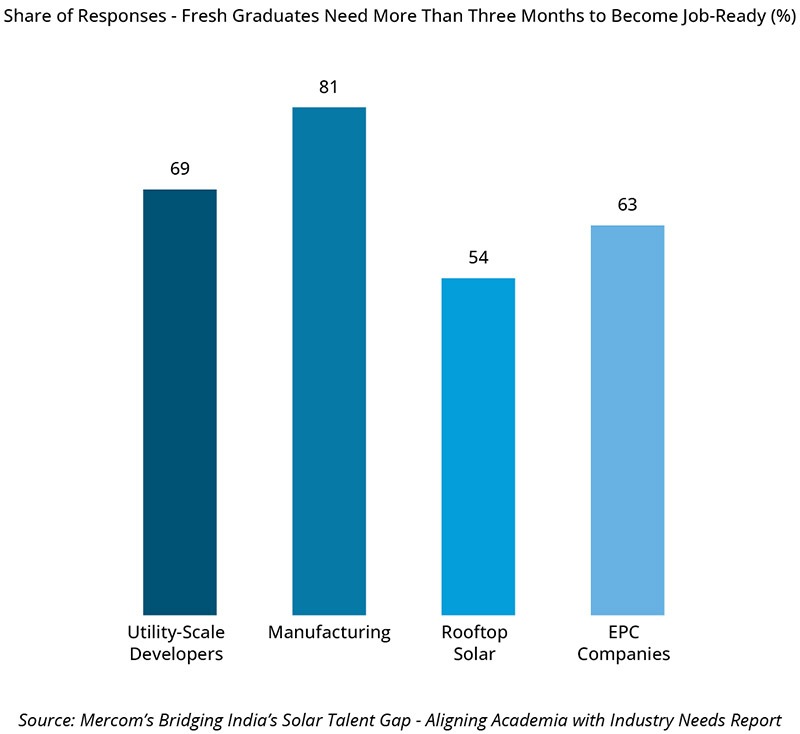
The majority of employers across the renewable energy value chain noted that fresh graduates need more than three months to become productive
October 15, 2026


Follow Mercom India on WhatsApp for exclusive updates on clean energy news and insights
India’s rapidly expanding solar industry is facing a growing workforce readiness gap, with employers across utility-scale project development, manufacturing, rooftop solar installation, and engineering, procurement, and construction (EPC) reporting that fresh graduates require substantial training before becoming productive, according to Mercom India’s newly released survey report: Bridging India’s Solar Talent Gap – Aligning Academia with Industry Needs.
Industry leaders have been drawing attention to the challenge even as India has initiated measures at the policy level to reduce its import dependence and position the country as a solar manufacturing hub.
At the Mercom India Renewables Summit 2026, stakeholders highlighted long training cycles, high attrition, and a shortage of practical skills among fresh graduates as key bottlenecks for renewable energy companies. They stressed the need to update academic curricula to reflect industry requirements and equip graduates with the skills needed to enter the workforce.
Developers need professionals with commercial, grid, and project execution capabilities. Manufacturing companies require workers who understand equipment, process discipline, and production environments. Rooftop EPC companies need practical skills in feasibility assessment, design, installation, and customer service.
Stakeholders have also been pushing for stronger industry-academia collaboration in research and proposed industry-led research and development consortiums to align academic work with near-term industry challenges.
Mercom India surveyed more than 100 industry participants across four major solar segments- utility-scale, manufacturing, rooftop, and engineering, procurement, and construction- to identify the extent of this skill gap in new graduates.
The study found the challenge extends beyond individual technical skills. Employers identified gaps across practical exposure, project execution, manufacturing processes, system design, regulatory understanding, commercial knowledge, troubleshooting, and site readiness.
“India’s solar industry is expanding rapidly, but the talent pipeline is not keeping pace with what companies need. Employers are spending significant time training fresh graduates before they can contribute effectively in project development, manufacturing, rooftop solar, and EPC roles. Academic programs need much stronger exposure to current technologies, operating projects, factories, site conditions, regulations, and the commercial realities of the evolving industry. Greater cooperation between industry and academia is critical to closing this gap,” said Raj Prabhu, CEO of Mercom Capital Group.
According to the survey, nearly three-quarters (74%) of manufacturing respondents said it could take between three and 12 months to become productive, while another 7.4% said the process takes more than a year.
Forty percent of respondents said 25% to 50% of new hires require retraining, while 29.6% said the proportion was between 51% and 75%.
Nearly two-thirds of utility-scale solar respondents (62.5%) said more than half of their new hires need significant retraining before becoming productive, including 37.5% who said this applies to over 75% of new hires.
Half of the utility-scale solar respondents believe fresh graduates do not understand grid congestion and curtailment risks. EPC companies also reported extended ramp-up periods.
Fifty-four percent of rooftop solar companies said fresh graduates take more than three months to become productive, including 16% reporting six to twelve months and 13.5% reporting more than a year.
The survey shows that the nature of the skill gap differs across the solar value chain. Among utility-scale developers, 75% identified lack of practical exposure as the biggest hiring bottleneck. Respondents also highlighted gaps in project feasibility assessment, grid and regulatory processes, and commercial understanding, indicating limited exposure to how projects move from development to commissioning.
Solar manufacturing companies reported different challenges. About 37% of respondents cited a lack of practical exposure as the biggest hiring bottleneck, followed by limited familiarity with current technologies at over 33%. Gaps were also reported in troubleshooting, quality assessment, production processes, and understanding factory performance metrics.
Rooftop solar companies highlighted gaps in field exposure, practical system design, customer interaction, and regulatory processes. Nearly 60% identified either a lack of field exposure or weak practical design knowledge as the biggest hiring challenge.
EPC companies similarly emphasized practical site readiness. About 88% identified lack of field exposure, weak technical knowledge, or limited understanding of project development as the leading hiring challenges. Only about 42% said graduates can work effectively on live project sites, indicating difficulty translating engineering knowledge into real-world construction, commissioning, and project execution.
The survey also showed that industry is willing to help address the problem.
More than 83% of respondents in every segment said they would support internships, site exposure, factory visits, or training partnerships. Manufacturers showed the strongest interest at 96%, indicating substantial scope for structured industry-academia collaboration focused on practical, industry-relevant training.
“The industry is clearly willing to participate in solving this problem. Companies across all four segments are open to internships, site exposure, factory visits, and training partnerships. What is missing is a structured mechanism and effort that brings industry and academia together regularly, so curricula and practical training keep pace with how quickly the solar market is changing,” Prabhu added.
Mercom India’s Bridging India’s Solar Talent Gap – Aligning Academia with Industry Needs examines workforce readiness across utility-scale solar development, solar manufacturing, rooftop solar, and EPC companies. The study assesses graduate readiness, productivity timelines, retraining requirements, practical skill gaps, hiring bottlenecks, and industry willingness to support internships and training partnerships. The findings highlight areas where industry, educational institutions, and policymakers can better align workforce development with the evolving needs of India’s solar sector.
For the complete survey report, visit: https://www.mercomindia.com/product/bridging-india-solar-talent-gap
To download the report, visit: https://www.mercomindia.com/product-form/bridging-india-solar-talent-gap-survey-report-form


Melvin Mathew
More articles from Melvin Mathew.