


India’s Rooftop Solar Capacity Rises 127%, Reaches 11.2 GW in 9M 2026
The country added 4.7 GW of rooftop solar capacity in Q3 2026
November 26, 2026

Follow Mercom India on WhatsApp for exclusive updates on clean energy news and insights
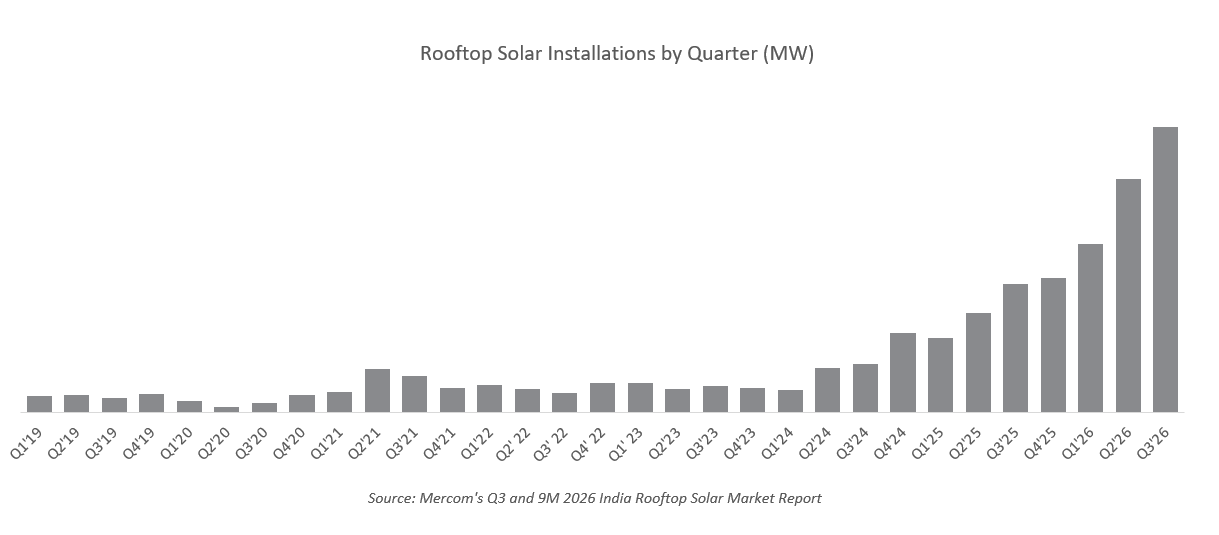
India added 11.2 GW of rooftop solar capacity in the first nine months (9M) of calendar year (CY) 2026, up 127.5% year-over-year (YoY) from 4.9 GW, according to Mercom India’s newly released Q3 and 9M 2026 India Rooftop Solar Market Report.
The country’s rooftop installations rose 122% YoY in the third quarter (Q3) to 4.7 GW from 2.1 GW. Installations rose 22% quarter-over-quarter from 3.8 GW.
“PM Surya Ghar has changed the scale of India’s residential rooftop solar market and is driving record growth. With the current program scheduled to end in March 2027 and millions of applications still pending, the focus has to be on converting that demand into installations through faster financing, smoother DISCOM processes, adequate equipment availability, and stronger vendor capacity. There also needs to be early clarity on PM Surya Ghar 2.0 so the market does not lose momentum and consumers, installers, and manufacturers can plan beyond the current program,” said Raj Prabhu, CEO of Mercom Capital Group.
The PM Surya Ghar program continued to support growth, with nearly 5.95 million households installing rooftop solar by September 2026. Another 3.7 million applications are pending, representing an estimated 10.96 GW residential pipeline at 3 kW per system.
Residential installations accounted for about 9.9 GW in 9M, followed by industrial at 800 MW and commercial at 500 MW, with the remaining capacity coming from government installations.
Residential demand remained strong, supported by subsidy-led adoption and increasing consumer interest in rooftop solar. However, approval timelines, financing, subsidy processing, and module availability continued to affect project execution across some markets.
Rooftop solar accounted for more than 42% of India’s total solar installations during Q3.
Residential installations remained the leading contributor in Q3, accounting for 95.2% of quarterly additions. Industrial, commercial, and government segments contributed 2.5%, 1.7%, and about 0.6%, respectively.
According to the report, commercial rooftop installations declined during the quarter as higher project costs, financing constraints, and state-level regulatory changes affected investment decisions. Businesses continued to evaluate rooftop solar primarily for daytime self-consumption, electricity savings, and payback periods, while OPEX/RESCO models provided an alternative to upfront investment.
Industrial rooftop installations also declined, with investment decisions increasingly influenced by electricity tariffs, load profiles, project payback periods, financing conditions, and how surplus generation is treated. Battery storage continued to attract interest among larger consumers seeking peak-demand management and greater supply reliability.
Priya Sanjay, Managing Director at Mercom India, highlighted that the transition to Approved List of Models and Manufacturers (ALMM) List-II compliance has created market uncertainty. The industry was awaiting clarity on a possible extension of the compliance deadline, which slowed installations in Q2 and Q3. “Even projects that were ready for commissioning had to reassess their compliance requirements, particularly in the commercial and industrial (C&I) segment.”
Installations under the capital expenditure model dominated Q3 2026, contributing 92%, while the operational expenditure/renewable energy service company model accounted for 8%.
Domestic content requirement (DCR) and ALMM are increasingly influencing procurement and project decisions. Limited availability of DCR-compliant modules, higher prices, advance-booking requirements, and extended delivery timelines are affecting project closures.
 Average rooftop solar system costs showed mixed movements in Q3 2026, ranging from ₹29.7 million (~$319,904)/MW for Chinese mono PERC systems to ₹44.4 million (~$478,240)/MW for Indian TOPCon DCR systems. DCR-compliant systems remained the most expensive among module types.
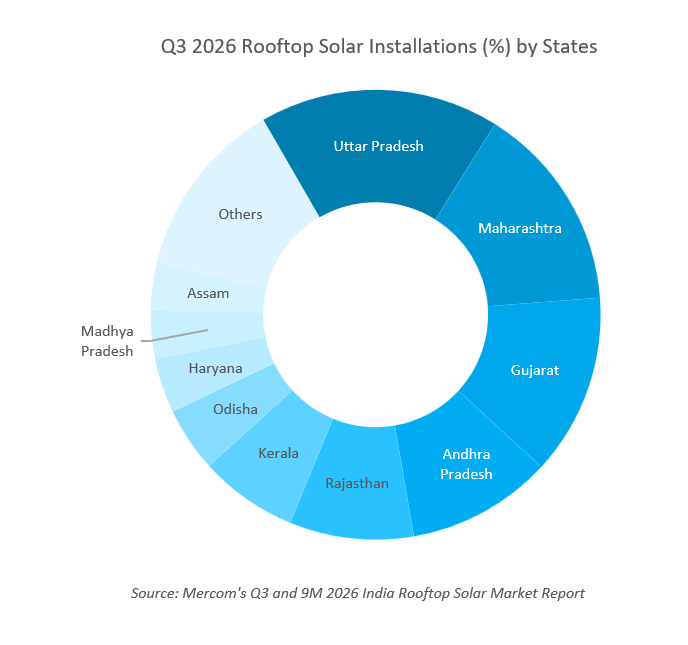
Uttar Pradesh, Maharashtra, and Gujarat led quarterly installations, accounting for 17%, 15%, and 13%, respectively.
Cumulative rooftop solar installations reached 32 GW as of September 2026.
The top 10 states accounted for 81%, with Gujarat, Maharashtra, Uttar Pradesh, Rajasthan, and Kerala leading installed capacity.
Sanjay said the proposed integration of battery storage systems with rooftop solar is likely to have a limited impact on the residential segment, while its implications for commercial and industrial (C&I) consumers could be more significant.
She noted that some commercial consumers are already deploying battery storage, as higher electricity tariffs make storage economically viable. However, the economics remain less attractive for industrial consumers.
Assam recorded the highest compounded quarterly growth rate between Q3 2025 and Q3 2026 at 29%, followed by Andhra Pradesh and Uttar Pradesh at 24% and 22%, respectively.
Sanjay noted that while rooftop solar continues to offer substantial savings, the extent of these savings has declined marginally, resulting in longer payback periods.
“The biggest challenge facing the industry is policy uncertainty. As the December 31, 2026, deadline approaches, much of the industry is anticipating an extension, but there is still no clarity. Prolonged uncertainty could slow the pace of installations in the coming quarters.”
Mercom forecasts strong growth in India’s rooftop solar market for the remainder of 2026, with residential projects expected to remain the main contributor. The large residential pipeline, rising C&I adoption, and evolving business models are expected to drive further deployment. The pace of additions will depend on project execution, equipment availability, financing, and DISCOM processes.
Residential installations are forecast to increase 172.7% YoY, while commercial installations could grow 222.6%. Industrial additions are expected to increase 30.3%, while government installations are forecast to rise 91% YoY. Around 86% of installations are expected under the CAPEX model and 14% under OPEX/RESCO, reflecting the continued dominance of residential rooftop solar.
The Q3 and 9M 2026 Mercom India Rooftop Solar Report covers installations, market trends, state-level developments, system costs, investments, tenders, policies, and forecasts across India’s rooftop solar market.
For the complete report, visit: https://www.mercomindia.com/product/rooftop-solar-market-report-q3-2026


Melvin Mathew
More articles from Melvin Mathew.