


India’s Solar Open Access Capacity Up 6 GW in 1H 2026
The country’s cumulative solar open access capacity stands at 36 GW
August 20, 2026

Follow Mercom India on WhatsApp for exclusive updates on clean energy news and insights
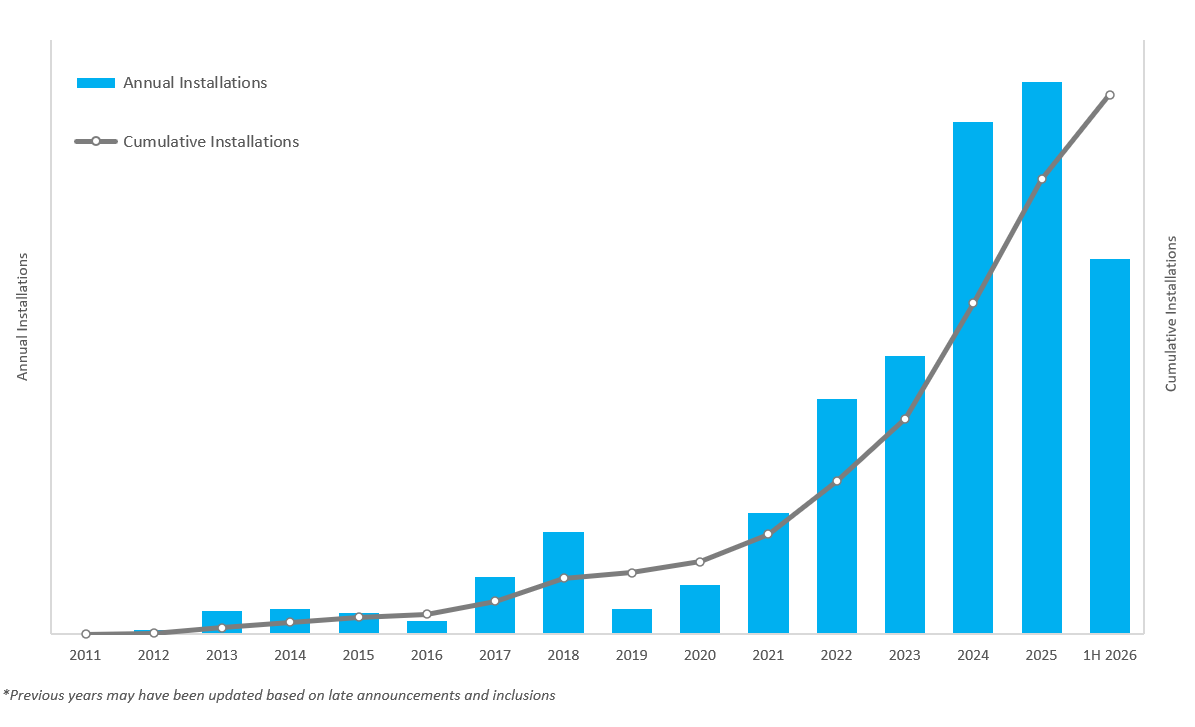
India added nearly 6 GW of solar open access capacity in the first half (1H) of the calendar year 2026, up 42% year-over-year (YoY) compared to 4 GW, according to Mercom India’s newly released Q2 2026 India Solar Open Access Market Report.
In the second quarter (Q2), 3 GW of solar open access capacity was added, the highest quarterly addition on record, and an increase of 10% quarter-over-quarter (QoQ).
As of June 2026, India’s cumulative installed solar open access capacity stood at 36 GW.
Installation activity during 1H 2026 was shaped by regulatory deadlines and evolving market conditions. Developers accelerated procurement and project commissioning ahead of the phased reduction in the interstate transmission system charges waiver and the implementation of sourcing requirements under the Approved List of Models and Manufacturers (ALMM) List-II.
Although the ALMM List-II compliance deadline for open access projects was later deferred to the end of 2026, the relief came only after the original deadline had passed, prompting many developers to advance their procurement and commissioning schedules.
Priya Sanjay, Managing Director at Mercom India, said that the record installations and a large pipeline demonstrate the strength of underlying demand from commercial and industrial (C&I) consumers.
Rising project costs, transmission constraints, changing banking and open access regulations, and domestic sourcing requirements are pressuring project economics. “The opportunity remains significant, but growth will increasingly depend on states providing predictable regulations and developers being able to deliver projects at tariffs that continue to offer meaningful savings to consumers,” she said.
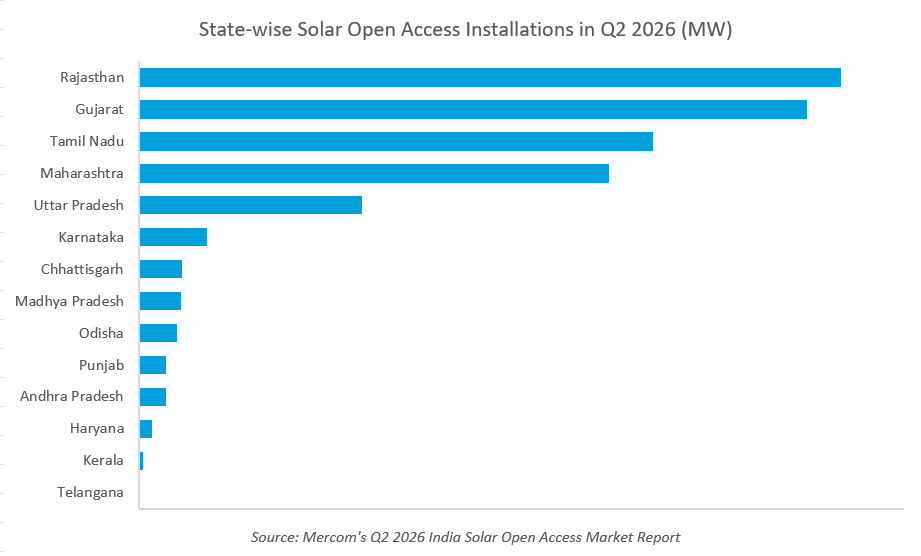
Rajasthan led solar open access capacity additions in Q2 2026, accounting for 25% of the total, while the top five states contributed 91% of quarterly installations.
Demand across these markets came from a broad base of C&I consumers, including automotive, cement, chemicals, electrical and electronics, fast-moving consumer goods, healthcare, information technology, data centers, petroleum, pharmaceuticals, and textiles sectors.
Sanjay highlighted that solar project costs are expected to rise, as ALMM-II-compliant modules are likely to be more expensive than non-DCR modules. She added that developers are expected to accelerate project execution to capture the cost benefits from the ALMM extension for open access projects, although their ability to do so will depend heavily on securing timely grid connectivity.
Karnataka led with a 21% share, followed by Rajasthan and Maharashtra at 16% each. Together, the top five states accounted for 77% of cumulative capacity, reflecting the market’s continued concentration in states with strong industrial demand and established open access frameworks.
The development pipeline in the top solar open access states also remains substantial. Rajasthan had the largest pipeline, followed closely by Maharashtra and Karnataka.
In the first two months of 2026, Karnataka emerged as the leading seller in the Green Day-Ahead Market (G-DAM), accounting for 35% of electricity sold. Punjab was the leading procurer from G-DAM, followed by Damodar Valley Corporation and Gujarat.
The volume traded in the Green Term-Ahead Market (G-TAM) on IEX was 67.2 MU in these two months.
The cleared volume of renewable energy certificates (RECs) traded on the Indian Energy Exchange declined 86% compared to Q1 2026. The sharp fall in REC trading followed elevated activity in Q1, when obligated entities stepped up purchases ahead of the financial year-end to meet renewable purchase obligation requirements.
Looking ahead, Sanjay said that while the ALMM-II extension is expected to accelerate project execution, developers’ ability to capitalize on the opportunity will depend on the regulatory environment and how effectively they absorb additional costs arising from state-level mandates, including storage requirements such as those in Maharashtra.
She added that if developers can overcome these bottlenecks, the period through December presents a strong window for project execution.
The report tracks how market and regulatory shifts are affecting project economics across 13 major states, with state-level analysis of retail tariffs, power purchase agreement prices, open access charges, installed capacity, and the development pipeline.
The Q2 2026 Solar Open Access Market Report by Mercom India provides vital market data and insights. For the complete report, visit:
https://www.mercomindia.com/product/q2-2026-mercom-india-solar-open-access-market-report


Melvin Mathew
More articles from Melvin Mathew.