India Needs Stronger Power Regulators as Energy Transition Accelerates: Interview
The foremost priority is to strengthen the institutional capacity of regulators
July 28, 2026
Follow Mercom India on WhatsApp for exclusive updates on clean energy news and insights
India’s power sector is undergoing a rapid transformation with the share of renewables surging, the emergence of new technologies, and evolving business models. The country’s regulatory framework has adapted well to the changing trends, although there is a need for an enhancement of institutional capacity.
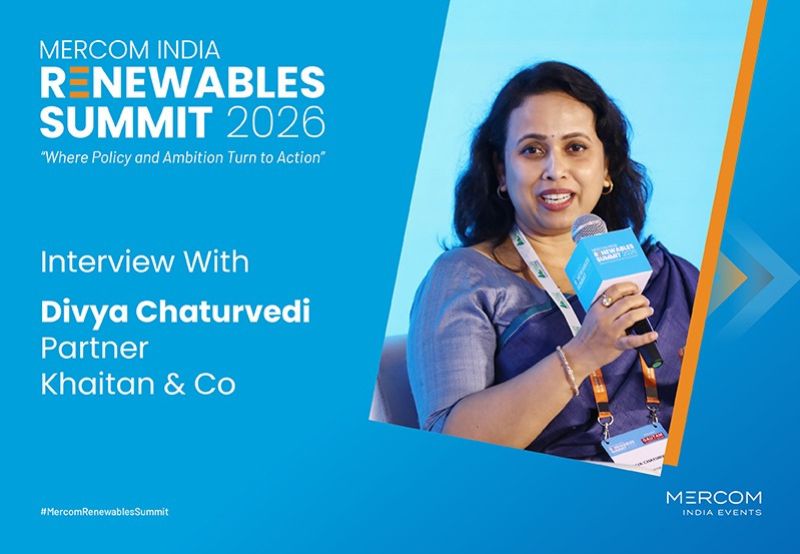
In an interview on the sidelines of the Mercom India Renewables Summit 2026 held in New Delhi on July 1 and 2, Divya Chaturvedi, Partner at Khaitan & Co., discusses how India’s electricity regulators have adapted to the energy transition, while highlighting the urgent need to strengthen institutions such as the Appellate Tribunal for Electricity and the state electricity regulatory commissions. She also shares her views on transmission bottlenecks, data center regulations, parallel distribution licensing, and the legal and policy challenges that will shape the next phase of India’s clean energy growth.
Excerpts from the interview:
How do you assess India’s renewable energy regulatory landscape today?
The regulatory framework has evolved significantly. Even the Electricity Act, 2003, had a clear focus on promoting renewable energy, demonstrating that policymakers recognized its importance early on. Over the past decade, the biggest positive has been the regulators’ responsiveness. They have shown the ability to quickly adapt regulations to changing market requirements instead of taking years to introduce reforms. From our experience, policymakers and regulators remain closely aligned with industry concerns and have generally responded constructively to emerging issues.
Stakeholders often point to the multiplicity of regulatory forums such as the CERC, State Commissions, APTEL, High Courts, and the Supreme Court. Does this create delays?
The legal framework is quite clear. Supreme Court judgments over the years have defined when disputes should be taken before regulatory commissions and when constitutional courts can be approached.
The real bottleneck is not jurisdictional confusion but institutional capacity, particularly at the Appellate Tribunal for Electricity (APTEL). The tribunal still operates with a structure designed when India’s installed power capacity was just over 100 GW. Today, the system supports more than 500 GW of capacity, significantly increasing the number and complexity of disputes.
APTEL is currently handling over 1,500 pending matters, with some cases pending for more than a decade. As electricity markets become more sophisticated with battery storage, data centers, and artificial intelligence driving new business models, the dispute resolution framework has not expanded at the same pace.
What reforms would help reduce these delays?
The foremost priority is strengthening institutional capacity. Regulatory commissions can recruit consultants and technical experts under their regulations. Some, including CERC, have done this effectively. In the case of APTEL, increasing the tribunal’s institutional strength, expanding membership, and bringing in more young professionals would help considerably.
Regional benches could also improve accessibility, as the system has become highly Delhi-centric. Stakeholders from distant states still have to approach Delhi for appellate proceedings.
In addition, there should be a more structured mechanism through which the Ministry of New and Renewable Energy (MNRE) regularly engages with industry stakeholders. Today, policy interventions often happen on an ad hoc basis after issues arise.
Has the regulatory system kept pace with the rapid growth of renewable energy?
Despite the challenges, I believe regulators have done a commendable job. They have generally been solution-oriented, balancing legal requirements with commercial realities faced by developers. We have also seen disputes gradually shift from state commissions to CERC because electricity transactions increasingly involve interstate power flows.
That naturally increases pressure on central institutions, reinforcing the need for additional benches, more members, and greater institutional capacity.
Renewable energy now includes hybrid projects, battery storage, and firm dispatchable renewable energy. Have regulators developed sufficient technical expertise?
The Electricity Act always envisioned technically qualified members serving on regulatory commissions and APTEL, and that has helped.
In practice, lawyers and project developers also play an important role in explaining emerging technologies during proceedings. What stands out is the willingness of regulators to learn and adapt. Over two decades of practice, I have found the power sector to be remarkably receptive to technological change.
Technical capability has not been the primary constraint. Capacity and workload have.
What services does Khaitan & Co. provide to the renewable energy sector?
We provide comprehensive legal support across the renewable energy value chain.
Apart from electricity litigation and regulatory matters, we advise on project development, land acquisition, real estate due diligence, financing, banking documentation, capital markets, technology, and artificial intelligence-related issues.
As a full-service firm with 19 offices across India and over a century of experience, we combine expertise from multiple practice areas to deliver integrated solutions for clients.
Renewable energy companies have increasingly accessed capital markets. Is this also an area where you advise clients?
Yes. Capital raising has become an important part of renewable energy growth, whether through IPOs or other financing routes. We have a strong capital markets practice and often bring together specialists from multiple teams to develop solutions tailored to clients’ requirements.
How do you see the next stage of evolution of India’s renewable energy sector?
Developers have made remarkable progress, and India is close to achieving its renewable energy ambitions. The next major challenge is transmission infrastructure. Transmission capacity continues to lag generation capacity, and qualification requirements often make it difficult for private players to participate in transmission projects.
Cybersecurity is another emerging concern. Much of the equipment continues to be imported from a limited number of countries, and as the grid becomes increasingly digital, cyber resilience will become critical.
Transmission projects continue to face land acquisition and right-of-way challenges. How does your firm support clients in this area?
We regularly advise transmission companies on land-related issues, right-of-way disputes, regulatory approvals, and litigation.
Land remains a state subject, which means every state follows different policies and procedures. Greater policy harmonization would improve regulatory certainty and facilitate investment.
Ultimately, India needs to function more like a unified electricity market rather than a collection of separate state-level systems.
Several states are considering distribution licenses for data centers. How do you view these developments?
State governments are actively exploring different regulatory models. Uttar Pradesh, for instance, has introduced policies that facilitate parallel distribution licensing under certain conditions. Many data center developers are also evaluating captive and commercial & industrial procurement models.
At the same time, distribution companies remain concerned about losing high-value consumers, creating resistance in some states. While there is ongoing debate, governments recognize the economic importance of attracting data center investments and are generally trying to accommodate these developments within the existing legal framework.
Could these models face legal challenges, particularly after the Supreme Court’s judgment in the Indian Railways case?
The Railways judgment addressed a different issue: whether the Railways qualified as a distribution licensee.
Data center structures differ depending on whether they involve captive consumption, commercial procurement, or distribution to third parties. Developers are carefully structuring projects within the existing regulatory framework, although debates continue.
It would be premature to predict litigation outcomes because many of these models are still evolving.
With AI, green hydrogen, and data centers expected to drive electricity demand, what regulatory challenges do you anticipate?
Environmental issues, particularly water consumption by data centers, are likely to become increasingly important.
Another key issue is the need for a highly reliable electricity supply. Many large consumers continue to rely partly on captive power because distribution utilities cannot always provide the level of reliability they require.
For now, however, the sector remains largely in the investment and transaction phase rather than the litigation phase. Both central and state governments appear keen to facilitate AI and data center investments rather than allow regulatory disputes to slow their growth.