India Identifies Over 102 GW Floating Solar Potential
The country’s total assessed solar potential stands at over 3,445 GW
June 11, 2026
Follow Mercom India on WhatsApp for exclusive updates on clean energy news and insights
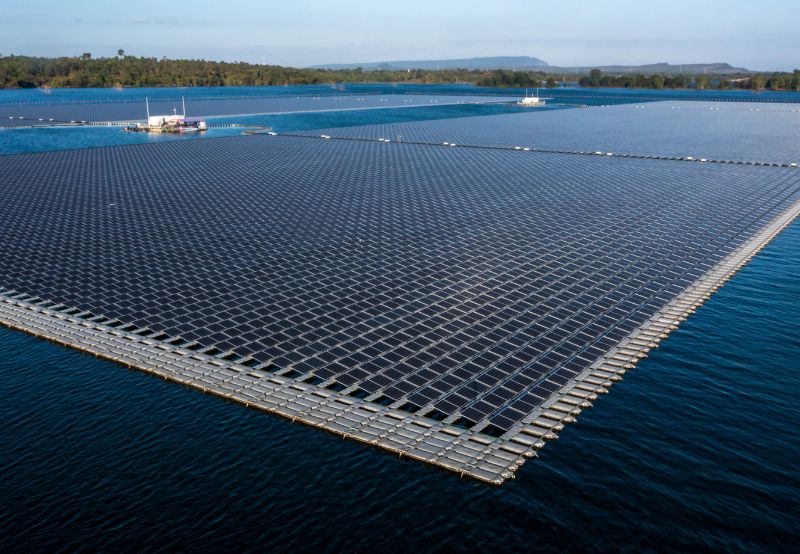
The Ministry of New and Renewable Energy (MNRE) has assessed India’s floating solar potential at over 102.18 GW and said it is working on a dedicated program to promote floating solar deployment nationwide.
Union Minister for New and Renewable Energy and Consumer Affairs, Food and Public Distribution, Pralhad Venkatesh Joshi, released the Report on Floating Solar PV Potential Assessment of India on June 10, 2026. The report takes India’s total assessed solar potential to 3,445 GW.
Floating solar projects use water surfaces, such as reservoirs and other bodies of water, to host solar systems. Joshi said reservoirs and other water bodies are emerging as assets for clean energy generation through floating solar projects.
Joshi also launched an online portal for the Small Hydro Power Development Scheme. He said the portal would improve transparency and implementation efficiency and described it as the first major policy intervention in the small hydro sector since 2017.
According to Joshi, India’s non-fossil fuel capacity increased from 81 GW in 2014 to 288 GW, while solar capacity rose from 2.8 GW to 155 GW. He also said domestic solar module manufacturing capacity had reached 192 GW and cell manufacturing capacity had reached 30 GW.
The National Institute of Solar Energy (NISE) and the Military Engineering Services also exchanged a memorandum of understanding to promote solar energy across defense establishments. Under the collaboration, NISE will provide technical support for planning, implementation, and monitoring of renewable energy projects.
Earlier this year, MNRE sought feedback from the states on the draft reports prepared by the NISE and the Indian Institute of Technology Roorkee on the potential of floating solar and the policy framework.
The documents assess India’s floating solar potential and propose a policy framework covering site identification, project execution guidelines, stakeholder roles, approvals, scheduling, and measures to reduce risks for developers and investors.
Deepak Ushadevi, MD and CEO at Ciel et Terre Solar, noted that floating solar is set to become a major driver of India’s renewable energy growth, not just a niche segment offering key advantages over ground-mount systems, such as no land acquisition requirements, faster scalability, and higher generation.