


Gujarat May Need 50 Tons a Day of Solar Module Recycling Capacity by 2035
The state’s solar waste generation may reach 50,000 tons annually by 2050
November 13, 2026

Follow Mercom India on WhatsApp for exclusive updates on clean energy news and insights
Gujarat is one of India’s leading states for solar installations. As of June 2026, the state ranked second in cumulative large-scale solar installations, with approximately 30.1 GW of installed capacity, representing 22% of the national total.
However, the rapid growth of solar capacity is also expected to create a growing challenge in managing end-of-life solar modules and the resulting waste. With a large installation pipeline, Gujarat’s annual solar module waste generation could increase from less than 1,000 tons in 2026 to approximately 20,000 to 70,000 tons during 2040 to 2050, according to a study by researchers from Pandit Deendayal Energy University and King Khalid University.
The state could need approximately 50 tons per day (TPD) of solar module recycling capacity by 2035 and more than 200 TPD by 2050, the study estimated.
Researchers modeled solar module waste generation in Gujarat from 2026 to 2050 under different solar deployment and module lifespan scenarios. They also assessed recycling infrastructure needs, material recovery, and the financial viability of recycling facilities.
Under the baseline scenario, which assumes a 30-year average module lifespan, annual solar waste could reach approximately 50,000 tons by 2050. The researchers also modeled a 35-year lifespan and an accelerated retirement scenario with a 25-year average lifespan.
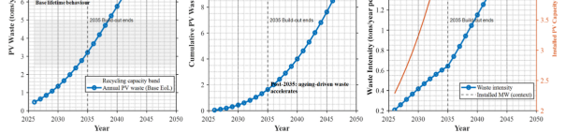
The study projected annual and cumulative solar module waste under different retirement scenarios. Source: Tiwari et al., Waste Management (2027), Fig. 4.
With a 35-year module lifespan, annual waste could reach approximately 35,000 tons by 2050, while cumulative waste could total 400,000 to 500,000 tons.
Under accelerated retirement, annual waste could approach 60,000 tons by 2050, with cumulative waste exceeding 1 million tons.
In a separate high-growth stress scenario, annual waste could approach 100,000 tons by 2050, with cumulative waste exceeding 1.2 million tons.
The study considered three solar deployment scenarios, with Gujarat’s cumulative installed solar capacity reaching 35 GW, 50 GW, or 65 GW by 2035.
According to the researchers, Gujarat’s installed solar capacity reached approximately 25 GW in 2025, compared with 7.8 GW in 2022. The state’s early solar installations, particularly those commissioned from 2010 to 2015, are expected to contribute to increasing module retirements during the 2030s.
Solar Recycling Infrastructure
Under the baseline scenario, Gujarat could generate approximately 3,000 tons of solar module waste annually by 2030, requiring about 15 TPD of recycling capacity.
By 2035, annual waste could increase to 8,000 to 10,000 tons, requiring approximately 40 to 50 TPD of recycling capacity.
By 2040, annual waste could reach approximately 20,000 tons, requiring about 100 TPD of recycling capacity.
By 2050, the baseline scenario projects around 225 TPD of recycling capacity for 50,000 tons of annual waste. Accelerated module replacement could increase waste to nearly 70,000 tons annually, requiring up to 315 TPD.
Retired Module Aggregation
The researchers recommended phasing in recycling capacity, starting with approximately 50 TPD by 2035, increasing to more than 100 TPD by 2040 and over 200 TPD by 2050.
They also proposed at least six regional collection hubs to aggregate retired modules before transporting them to recycling facilities.
Each hub could initially handle approximately 10,000 tons of solar waste annually, with capacity expanding as volumes increase.
Economic Viability
The researchers assessed the financial viability of a representative 100 TPD solar recycling facility with an estimated capital expenditure of ₹2.5 billion (~$27.5 million).
The model assumes the facility would process approximately 25,500 tons of solar module waste annually, operating 300 days at 85% utilization.
The financial assessment considered a 15-year evaluation period, a 12% discount rate, and a 70:30 debt-to-equity ratio.
The study estimated recovered material revenue at ₹35,000 (~$385) to ₹55,000 (~$605) per ton of processed waste.
Silver contributed approximately 59% of modeled material recovery revenue, followed by aluminum at 21% and copper at 12%. Silicon and glass accounted for smaller shares.
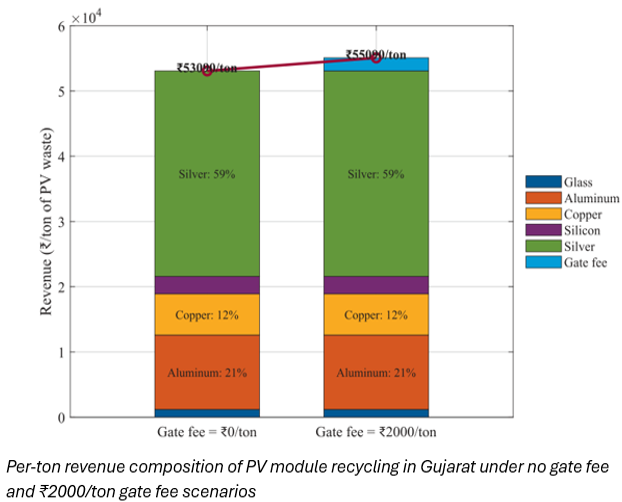
Silver recovery efficiency was the main factor affecting the modeled financial performance of solar recycling facilities.
Without a recycling gate fee, the facility’s estimated net present value (NPV) ranged from approximately $11 million to $31 million, with an internal rate of return (IRR) of 19% to 31%, depending on material recovery efficiencies.
A recycling gate fee of ₹2,000 (~$22) per ton increased estimated NPV to $14 million to $33 million and IRR to 21% to 33%.
The researchers also found that, under baseline material recovery assumptions, recycling facilities could achieve a positive NPV without gate fees at processing capacities of approximately 25 to 30 TPD.
Under more conservative recovery assumptions, the break-even capacity increased to approximately 50 TPD to 55 TPD.
The study estimated variable recycling costs of ₹6,200 (~$68) per ton.
Material Recovery and Policy
The researchers examined a process combining mechanical dismantling, thermal treatment, and chemical recovery of valuable materials.
They estimated that recycling could recover more than 95% of glass and aluminum and over 90% of certain metals from retired modules.
The researchers also cautioned that declining silver content in newer solar modules could affect future recycling economics.
The study recommended strengthening the implementation of extended producer responsibility provisions under India’s E-Waste (Management) Rules, 2022, to ensure that retired solar modules enter formal collection and recycling systems.
In March, the Central Pollution Control Board issued version 1.0 of the “Guidelines for Storage and Handling of Waste Solar Photovoltaic Modules or Panels or Cells” under the E-Waste (Management) Rules, 2022. The guidelines prescribe operational standards for the transportation, handling, and storage of waste solar modules, panels, and cells to ensure environmentally sound.
Last year, the Gujarat Energy Development Agency invited expressions of interest for a research study to recover valuable materials from solar and electronic waste. The project aims to assess the feasibility of material recovery methods and develop an implementation roadmap to aid Gujarat’s renewable energy and waste management sectors.


Parth Shukla
More articles from Parth Shukla.