


Energy Storage-Backed Renewable Tenders Dominate Procurement in 1H 2026
Storage and hybrid projects accounted for over half of auctioned capacity as procurement shifted toward flexible and dispatchable renewable energy
August 11, 2026

Follow Mercom India on WhatsApp for exclusive updates on clean energy news and insights
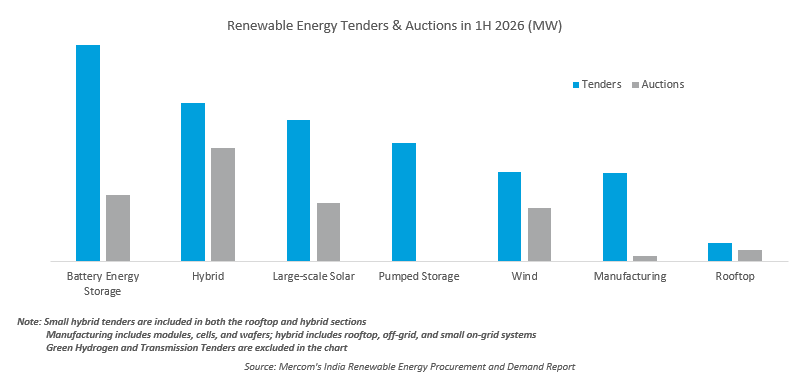
Agencies in India issued tenders for 44.1 GW and auctioned 16.3 GW of renewable energy capacity across energy storage, hybrid, utility-scale solar, wind, manufacturing, and rooftop solar projects in the first half (1H) of 2026, according to Mercom India’s newly released India Renewable Energy Procurement and Demand Report.
Battery energy storage and hybrid projects emerged as the dominant procurement categories, accounting for 45% of the total capacity tendered, reflecting the growing preference among procuring agencies for renewable energy projects that can deliver power beyond solar generation hours and better match demand profiles.
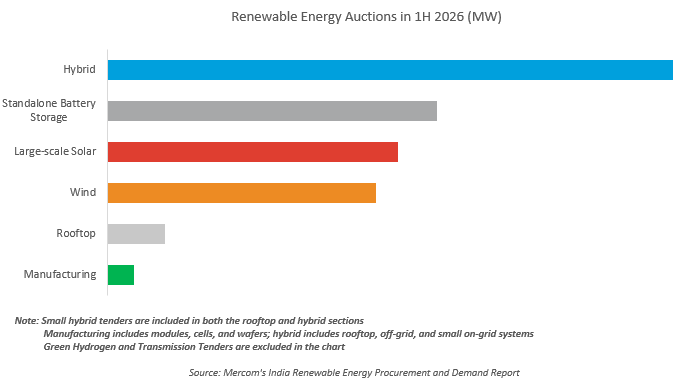
Hybrid projects accounted for the largest share of auctioned capacity at 37%, followed by energy storage at 21%. Utility-scale solar represented 19% of auctioned capacity, while wind contributed 17%. Rooftop solar and manufacturing projects accounted for the remaining 6%.
Together, hybrid and energy storage projects accounted for more than 58% of all auctioned capacity, underscoring the industry’s shift toward dispatchable renewable energy rather than standalone generation assets.
The changing procurement mix reflects a broader shift in how renewable energy is being procured. Rather than prioritizing capacity additions alone, implementing agencies are increasingly seeking projects that can supply electricity when needed, thereby improving grid flexibility and reducing renewable energy curtailment.
The changing procurement mix also highlights how rapidly India’s renewable energy market is evolving. Tracking technology preferences, tender structures, procurement agencies, and auction outcomes is becoming increasingly important for developers, equipment suppliers, manufacturers, and investors seeking to align their business strategies with emerging market demand.
Procurement also became more disciplined in 1H 2026 after the Ministry of New and Renewable Energy directed implementing agencies to clear pending power purchase agreements (PPAs) and power sale agreements (PSAs) before issuing fresh tenders.
The directive is expected to improve the conversion of awarded projects into contracted capacity while reducing the backlog of projects awaiting buyer commitments.
As procurement frameworks become more selective and project execution timelines come under greater scrutiny, market participants increasingly require visibility into tender pipelines, auction outcomes, contracting trends, and regulatory developments to assess project opportunities and execution risks.
Utility-scale solar continued to account for a significant share of procurement activity, with more than 7 GW of capacity tendered and 3 GW auctioned during 1H 2026. Wind tenders totaled 5 GW, while 3 GW of capacity was auctioned.
While utility-scale solar continues to offer the lowest-cost renewable electricity, wind complements solar generation by extending renewable energy availability into non-solar hours, making the two technologies increasingly complementary within hybrid projects.
“Procurement trends in 1H 2026 show a clear shift from target-based tendering to demand-aligned procurement. Hybrid and battery storage projects accounted for more than half of the auctioned capacity, reflecting the growing need for flexible, dispatchable power. Going forward, the industry can expect more tenders designed around each DISCOM’s need for power that better matches its demand profile. The pace of auctions will depend on buyer commitments, transmission readiness, realistic tariffs, and the ability to convert awarded capacity into signed PPAs and PSAs,” said Raj Prabhu, CEO of Mercom Capital Group.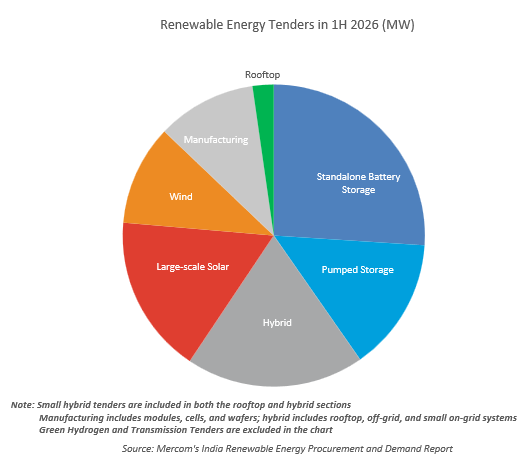
The evolving procurement landscape also reflects a broader transition in India’s renewable energy market, where project viability increasingly depends on factors beyond tariffs, including transmission readiness, buyer commitments, storage integration, and supply-chain availability.
Implementing agencies also adopted a more selective approach to issuing new tenders, placing greater emphasis on buyer readiness, transmission availability, project viability, and the likelihood of timely execution of PPAs and PSAs.
Although developer interest remained strong for well-structured tenders, projects facing uncertain grid connectivity or delayed offtake arrangements continued to progress more slowly.
Government agencies and public sector enterprises issued module supply tenders totaling more than 4 GW as demand for domestically manufactured solar modules increased. As of June 2026, approximately 28 GW of tendered module supply capacity awaited auction.
Rooftop solar procurement remained relatively subdued, with nearly 1 GW tendered and about 600 MW auctioned. Higher project costs, supply constraints, and policy uncertainty continued to weigh on procurement activity in the distributed solar segment.
The implementation of the Approved List of Models and Manufacturers List II for solar cells is beginning to influence procurement across the solar value chain. Rising demand for domestically manufactured modules has supported module supply tenders, while limited availability of cells compliant with domestic content requirements has tightened supply.
The report also examines how evolving domestic manufacturing requirements, storage deployment, transmission readiness, and procurement policies are influencing tender design across different renewable energy segments.
The transition has also affected rooftop solar procurement, with higher system costs and component shortages slowing tender activity in the distributed solar segment alongside changes and delays related to net metering, banking provisions, and other regulatory developments.
Green hydrogen procurement continued to evolve toward commercial deployment, with agencies increasingly focusing on industrial applications, supporting infrastructure, and long-term offtake arrangements required to establish the sector’s commercial ecosystem.
Transmission-related tenders remained focused on interstate and intrastate networks, substations, high-voltage transmission lines, network augmentation, and renewable energy evacuation infrastructure.
Beyond tender and auction data, the report analyzes procurement trends across solar, wind, hybrid, storage, manufacturing, rooftop solar, transmission, and emerging technologies, providing insights into how India’s renewable energy market is evolving.
The India Renewable Energy Procurement and Demand Report covers all facets of India’s renewable energy tendering and auction activity. For the complete report, visit:
https://www.mercomindia.com/product/india-renewable-energy-procurement-1h-2026


Arjun Joshi
More articles from Arjun Joshi.