

Daily News Wrap-Up: Solar Growth Exposes Talent Readiness Gap
Government earmarks ₹60 billion to deploy battery storage under GEC-III
October 16, 2026

Follow Mercom India on WhatsApp for exclusive updates on clean energy news and insights
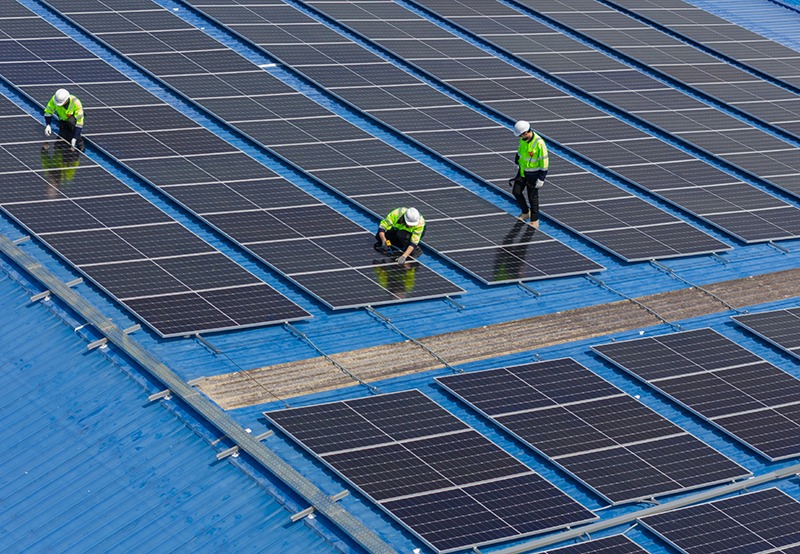
India’s rapidly expanding solar industry is facing a growing workforce readiness gap, with employers across utility-scale project development, manufacturing, rooftop solar installation, and engineering, procurement, and construction reporting that fresh graduates require substantial training before becoming productive, according to Mercom India’s newly released survey report: Bridging India’s Solar Talent Gap – Aligning Academia with Industry Needs.
The Union Cabinet earmarked ₹60 billion (~$631.11 million) for viability gap funding to support the deployment of 50 GWh of battery energy storage systems under the Green Energy Corridor (GEC) Phase-III program. The program aims to strengthen transmission infrastructure to facilitate the evacuation of 135 GW of renewable energy capacity.
Government think tank NITI Aayog urged the Ministry of Power and the Central Electricity Regulatory Commission to develop and publish model green tariff, banking, and open access principles for data centers’ procurement of round-the-clock renewable energy and battery storage-backed electricity.
The Central Electricity Authority revised its Manual on Transmission Planning Criteria, incorporating provisions for ultra-high-voltage alternating current transmission systems and updated modeling requirements for renewable energy projects, battery energy storage systems, and high-voltage direct current infrastructure.
The Central Electricity Regulatory Commission (CERC) adopted tariffs for 600 MW of interstate transmission system (ISTS) connected wind power projects awarded by SJVN.
CERC adopted tariffs for 1.2 GW of ISTS-connected wind power projects awarded by the Solar Energy Corporation of India. The adopted tariffs range from ₹3.67 (~$0.0386)/kWh to ₹3.69 (~$0.0388)/kWh.
The Uttar Pradesh Electricity Regulatory Commission approved a data center developer’s request to adopt tariffs for procuring 8 MW of renewable electricity on a short-term basis.
UPERC approved 10 power purchase agreements for 19.7 MW of grid-connected solar projects under Component C of the PM-KUSUM program. The Commission adopted tariffs ranging from ₹2.91 (~$0.0305)/kWh to ₹2.99 (~$0.0314)/kWh.
The Ministry of New and Renewable Energy invited Expressions of Interest from prospective agencies to select an expert institution to support the National Hydrogen Safety Panel under the government’s National Green Hydrogen Mission. The last date to submit applications is November 2, 2026.
The Indian Institute of Technology Palakkad invited bids to set up rooftop solar power systems at its Sahyadri Campus in Kerala. The last date to submit bids is November 3, 2026. Bids will be opened on the same day.
Bengaluru-based solar cell and module manufacturer Emmvee Photovoltaic Power reported revenue from operations of ₹15.76 billion (~$165.77 million) in the second quarter of the financial year 2027, up 39.4% year over year from ₹11.31 billion (~$118.96 million).
The United States International Trade Commission ruled that imports of crystalline silicon photovoltaic cells, whether assembled into modules or not, from India, Indonesia, and Laos materially injured the domestic solar manufacturing industry.
The Australian Renewable Energy Agency launched the third round of its Solar Sunshot program, offering up to AUD250 million (~$173.04 million) to support the manufacturing and commercialization of technologies that can reduce the cost and development time of large-scale solar projects. Expressions of interest will open on November 2, 2026.


Mercom Staff
More articles from Mercom Staff.