


Daily News Wrap-Up: Mercom Renewables Summit Returns for Sixth Edition
Rajasthan leads India’s solar open access market in Q1
June 8, 2026

Follow Mercom India on WhatsApp for exclusive updates on clean energy news and insights
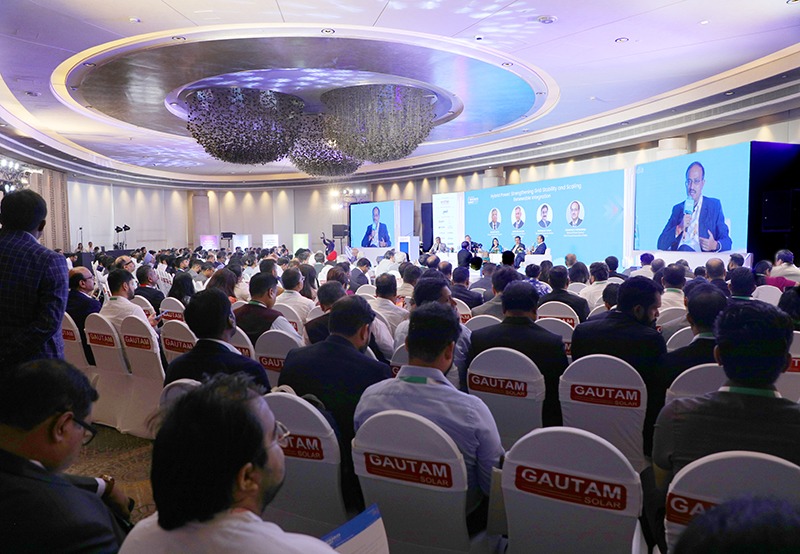
Mercom India’s sixth edition of its flagship event, the Mercom India Renewables Summit, will be held on July 1 and 2, 2026, at the Hyatt Regency in New Delhi. A key event in India’s renewable energy calendar, the Summit brings together industry leaders, policymakers, investors, developers, manufacturers, and technology providers to exchange insights and discuss the next phase of India’s clean energy growth.
Rajasthan emerged as the leading state for solar open access installations in the first quarter (Q1) of 2026. The state commissioned over 1 GW of solar open access capacity during the quarter, accounting for 39% of India’s newly added open access capacity, according to Mercom’s Q1 2026 India Solar Open Access Market Report.
The Punjab State Electricity Regulatory Commission approved Punjab State Power Corporation’s power purchase agreement to procure 4 MW of intra-state solar power from the Water Resources Department. The Commission approved a tariff of ₹2.97 (~$0.0311)/kWh. However, the Commission clarified that it did not approve the other terms and conditions of the PPA or the power sale agreement.
The Uttarakhand Electricity Regulatory Commission (UERC) retained the generic tariff for solar projects for projects commissioned during the financial year 2026-27. The Commission retained the tariff of ₹4.10 (~$0.0428)/kWh after reviewing the benchmark capital costs for solar, solar thermal, canal bank solar, canal top solar, rooftop, and small solar projects, as well as battery energy storage systems.
UERC issued the Draft Uttarakhand Electricity Regulatory Commission (Ancillary Services) Regulations, 2026, which proposes a framework for the procurement, deployment, and payment for ancillary services at the state level. Stakeholders can submit their feedback by July 3, 2026.
The Karnataka Electricity Regulatory Commission issued draft regulations proposing capacity limits, technical specifications, and a broader framework for grid-interactive distributed solar photovoltaic projects in the state. The Draft Karnataka Electricity Regulatory Commission (Grid Interactive Distributed Solar Photovoltaic Projects) Regulations, 2026, will apply to distribution licensees and eligible consumers in Karnataka.
The Andhra Pradesh Electricity Regulatory Commission (APERC) clarified that rooftop solar projects with installed capacities between 500 kW and 1,000 kW can continue to be billed under net/gross metering arrangements. Such projects must have been commissioned before the commencement of the APERC (The Grid Interactive Solar Rooftop Photovoltaic System under Gross/Net Metering) Regulation, 2023.
The Appellate Tribunal for Electricity (APTEL) set aside the Maharashtra Electricity Regulatory Commission’s order approving Maharashtra State Electricity Distribution Company’s proposal to procure 2,000 MW/4,000 MWh battery storage capacity through competitive bidding. APTEL also quashed the letters of intent issued to the appellants following the acceptance of their bids.
The Maharashtra Electricity Regulatory Commission approved the development of the 400/220 kV GIS Ambernath substation at Palava in the Thane district under the dedicated distribution facility framework through Option 1. Under Option 1, Lodha Developers will develop the substation at its own capital cost under the technical supervision, design standards, inspection, and control of the Maharashtra State Electricity Transmission Company.
The Tamil Nadu Electricity Regulatory Commission issued draft regulations to determine tariffs for intra-state transmission systems from the financial years 2028 to FY 2032. The Draft Tamil Nadu Electricity Regulatory Commission (Terms and Conditions for Determination of Tariff for Intra-State Transmission System) Regulations, 2026, cover aggregate revenue requirement, transmission tariff, true-up, mid-term review, annual performance review, and related matters.
The Telangana Electricity Regulatory Commission allowed distribution companies to levy fuel cost adjustment (FCA) charges of up to ₹0.30 (~$0.003)/kWh on consumers without the Commission’s prior approval. The revised rules allow FCA charges above ₹0.30 (~$0.003)/kWh to be adjusted during the process of pass-through of gains and losses on account of variations in the aggregate revenue requirement for the year.
Engineering Projects India invited bids for an engineering, procurement, and construction package to develop up to 250 MW of grid-connected solar power projects in Rajasthan. The project will be located near the 220 kV Bikaner IV substation at Ambaran. Bids must be submitted by June 15, 2026. Bids will be opened on June 16.
MJR Pearl, a residential apartment community in Whitefield, Bengaluru, installed a 150 kW rooftop solar project to reduce electricity costs and support its common-area power requirements. The project was installed by Beestone Solar India, a Bengaluru-based engineering, procurement, and construction company.
As industrial electrification gains momentum, heat pumps are emerging as an effective solution to reduce fuel consumption and improve energy efficiency. The pharmaceutical sector, in particular, is increasingly adopting heat pumps to lower operating costs and enhance profitability.
Wind energy solutions provider Inox Wind posted revenue of ₹12.44 billion (~$130.5 million) in the fourth quarter of the financial year 2026, a 2.4% year-over-year (YoY) decline from ₹12.75 billion (~$134 million). Earnings before interest, taxes, depreciation, and amortization stood at ₹2.61 billion (~$27.35 million), decreasing 10.1% YoY from ₹2.9 billion (~$30.42 million).
U.S.-based electric vehicle charging solutions company ChargePoint reported revenue of $101.8 million in the first quarter of fiscal year 2027, a 4.3% YoY increase from $97.6 million. Revenue for the quarter beat analysts’ expectations by $5.97 million. The revenue growth reflects improved demand, continued customer confidence in its platform, and disciplined execution.
Clean energy manufacturing investment in the U.S. continued to slow in Q1 2026, with businesses announcing $758.3 million in funding across 12 new electric vehicle, solar, battery, and grid projects between January and March, according to a report by E2. This is a decline from the $3.45 billion invested in Q1 2025.
France’s installed solar capacity reached 33 GW as of March 31, 2026, including 32.1 GW in mainland France, according to the Statistical Data and Studies Department. During the first quarter of 2026, 1.5 GW of new solar capacity was connected to the grid, comparable to the 1.57 GW added during the same period in 2025. The total connected solar fleet showed flat growth, with 1,379,173 installations totaling 32,996 MW, compared with 1,367,569 installations and 32,318 MW at the end of December 2025.
Utility-scale solar was the largest contributor to new clean power capacity in the U.S. in Q1 2026, adding 3.63 GW and accounting for 56% of all new clean power capacity additions, according to the American Clean Power Association (ACP). During Q1 2026, 6.4 GW of new clean capacity was added to the grid, a 17% YoY decline, according to ACP’s Clean Power Quarterly Market Report.


Mercom Staff
More articles from Mercom Staff.