Clean Energy Expansion Spurs Transmission Manufacturing Demand
Supply chain constraints are holding back faster grid expansion
July 3, 2026
Follow Mercom India on WhatsApp for exclusive updates on clean energy news and insights
A panel of experts at the Mercom India Renewables Summit 2026 highlighted the availability of growing opportunities for domestic players to step up manufacturing of power transmission equipment with the rapid buildout of renewable energy in India.
With the government promoting localization of the supply chains, and rising investments in grid modernization, the demand for transformers, gas-insulated switchgear, variable reactors, power conditioners, and other critical transmission components is growing, the panelists said.
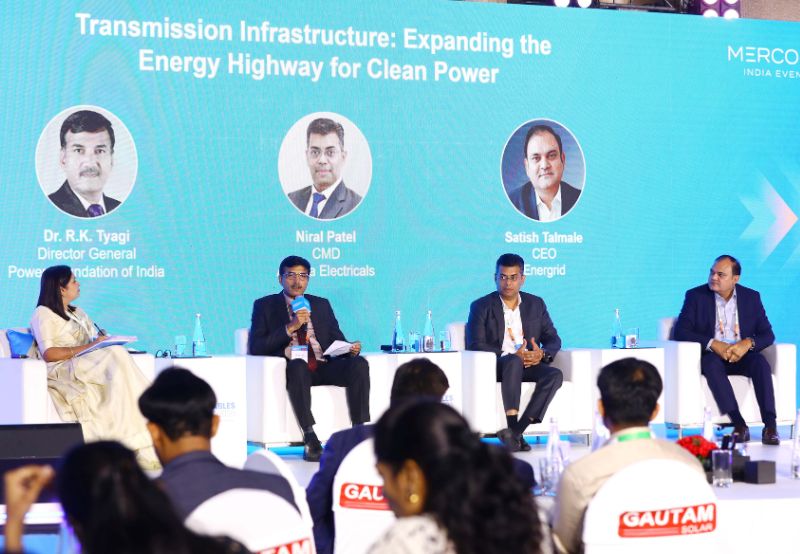
At a session titled, ‘Transmission Infrastructure: Expanding the Energy Highway for Clean Power,’ RK Tyagi, Director General at Power Foundation of India, said India has almost 540 GW of installed power capacity and more than 500,000 circuit kilometers of transmission lines. The country has about 15 lakh MVA of transformation capacity.
He said that in the past, thermal and hydro generation projects took six to eight years to be established, while transmission lines took around three to four years. Renewable projects can be set up in one to one-and-a-half years, while transmission lines still take three to four years. However, renewable energy parks such as Khavda and Pavagada have been provided with grid-connected infrastructure through timely commissioning of transmission lines.
Satish Talmale, CEO at EnerGrid, listed land acquisition, securing approvals, supply chain constraints, and shortage of skilled manpower as challenges for transmission services providers.
“The biggest disconnect is the misalignment between renewable energy and transmission development processes. Transmission guidelines and regulations have improved over the last two or three years, and states are adopting them. However, the wider operating environment remains challenging,” he said.
According to Talmale, farmers are usually not the core challenge. “In my view, only about 5% of farmers create difficulties. The larger issue is that other local and administrative elements get together and create problems. Addressing this requires administrative and political alignment.”
The panelists were unanimous in identifying supply chain constraints as a major challenge.
Talmale said that the industry was struggling to match the demand even for smaller components such as insulators. Developers are also facing extended delivery timelines for key components, resulting in project schedules getting seriously compromised.
Presenting a transformer manufacturer’s perspective, Niral Patel, Chairman and Managing Director at Atlanta Electricals, said transformer lead times have increased considerably. Before the recent demand surge, lead times were about six to nine months. They have now increased to about nine to 18 months.
The 500 GW renewable energy push has created a large requirement for transmission infrastructure. Transformer manufacturers were not fully prepared for this surge. Atlanta Electricals expanded capacity from about 16,000 MVA to about 62,000 MVA in roughly one-and-a-half years, helping it cater to demand, he added
Patel said the transformer industry is not insulated from supply chain constraints. Components such as bushings and insulation materials are also seeing extended timelines. Importing components does not solve the issue immediately because global suppliers are also facing capacity constraints.
With upcoming capacity additions in India, and new demand coming from power-intensive sectors, the demand-supply gap will likely take seven to 10 years to narrow down, Patel said
Responding to a question by moderator Priya Sanjay, Managing Director at Mercom India, about transmission availability being one of the biggest project risks, Tyagi said India has one of the strongest grids in the world. However, transmission projects face practical challenges.
“A 1,000 km transmission line may require around 3,000 towers. Even if 2,999 towers are ready, one unresolved tower location can block the entire line. In such cases, investment worth ₹4,000 crore to ₹5,000 crore can remain stuck because one tower cannot be constructed,” he said.
Calling on manufacturers to expand capacity without worrying about demand, Tyagi said India currently has about 540 GW of installed capacity. By 2030, the country will have to add about 260 GW. For this, about 750 GVA of additional transformation capacity may be required by 2030. India may need around 150 GVA of transformer manufacturing capacity every year, while current annual supply is closer to 100 GVA to 130 GVA.
On the transformer quality failure issue, Patel said problems such as moisture ingress and oil leakage can occur as transformers age. These are usually related to manufacturing quality, tank design, radiators, sealing, and maintenance.
He noted that some transformer failures are also linked to grid instability and reactive power issues. As renewable energy penetration grows, the grid sees more variability. Systems that help manage reactive power and stabilize the grid will become increasingly important.
About the risks that must be addressed as renewable energy injection into the grid grows, Tyagi said India has about 287 GW of non-fossil fuel and renewable energy capacity connected to the grid. High renewable energy penetration creates inherent challenges such as low inertia, voltage fluctuation, and oscillations.
“These challenges have already been seen in Rajasthan and Gujarat. There have been events where disturbances led to generation backing down by 5,000 MW to 7,000 MW. In one recent case, the backing down was close to 9,000 MW. These are real risks, and they need to be addressed collectively,” he said.
Tyagi said electricity currently accounts for about 20% of India’s total energy requirement. By 2035, India aims to increase it to 35%. For a developed economy, electricity consumption may need to reach about 50% of total energy use. For net zero by 2070, this may rise to around 70%.
India will need much larger renewable energy capacity by 2047 and 2070. This growth will bring challenges. The country needs ‘Make in India’ solutions for technologies required to integrate renewable energy, he added.
For clean energy integration, India needs technologies such as battery energy storage systems, pumped storage, synchronous condensers, high-voltage direct current systems, grid-forming inverters, and related infrastructure.
The panelists noted that synchronous condensers and high-voltage direct current systems are not readily available in India at scale. India cannot depend fully on China or Europe for these technologies. Domestic manufacturing and technology development are a must.
Talmale said cloud cover or sudden generation changes can create disturbances in the grid. To make the grid resilient, technologies such as high-voltage direct current systems, synchronous condensers, storage, and grid-support systems are critical. “The pace of adoption needs to increase. Storage is especially important. Without storage, renewable energy curtailment can become significant. In Rajasthan, curtailment reportedly led to settlement losses of more than ₹500 million in one week in May.”
The panelists discussed dynamic line rating and reactive power management technologies and their important use cases. Germany and other markets are already implementing such solutions, India needs faster deployment because bigger challenges are coming, they added
According to Patel, the government’s localization push is creating significant opportunities for local manufacturing. Atlanta Electricals has expanded capacity and is also looking at related equipment areas. Opportunities abound in reactors, power conditioners, gas-insulated switchgear, and other components of the transmission network. Transformers are only one part of the transmission system.