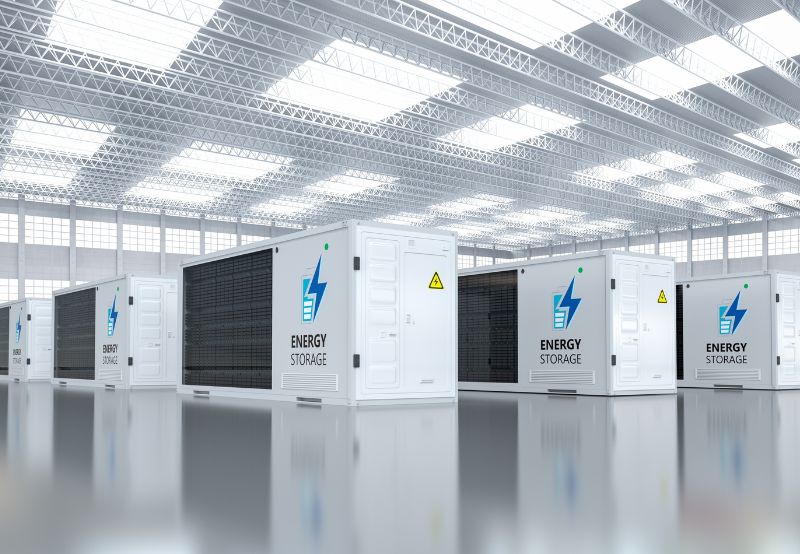
CEA Notifies Rules on Safety Framework for Battery Energy Storage Systems
April 2, 2026
Follow Mercom India on WhatsApp for exclusive updates on clean energy news and insights
The new rules mandate audits, fire safety systems, and design standards
The government has notified the Central Electricity Authority (Measures relating to Safety and Electric Supply) Amendment Regulations, 2026, introducing a comprehensive safety framework for battery energy storage systems (BESS).
The Central Electricity Authority (CEA) had issued the draft guidelines in June 2025.
The amended regulations will come into force on April 1, 2027.
Expanded Definitions
The amendments expand the definitions under Regulation 2 to formally include “battery energy storage systems,” defined as stationary systems connected to the electricity network using electrochemical storage, along with key components such as battery management systems (BMS) and power conversion systems (PCS).
The BMS monitors and controls battery parameters to ensure safe operation, while the PCS converts the direct current stored in the batteries into alternating current for grid injection, and vice versa.
The regulations also define “walk-in units” as prefabricated enclosures housing BESS equipment with personnel access for maintenance and servicing.
Comprehensive Safety Framework
A new Chapter XA, comprising Regulations 122(A) to 122(N), introduces additional safety requirements specifically for BESS installations, supplementing existing provisions. These requirements apply to systems connected at voltages exceeding 650 V, while installations at 650 V and below must comply with the relevant standards.
Under Regulation 122(B), general safety provisions mandate that PCS design must match battery chemistry and that systems incorporate two-fault tolerance, ensuring safe operation or shutdown even after two independent failures.
Testing must comply with applicable standards, and fire and explosion protection must be implemented at the cell, module, rack, container, and site levels.
The BMS is required to continuously monitor voltage, temperature, and thermal runaway conditions at multiple levels, triggering audiovisual alarms when parameters exceed prescribed limits and halting operations if temperature thresholds are breached.
The PCS must support fully automatic, unattended operation, including grid synchronization and disconnection, as well as built-in protective and diagnostic features. Cooling systems must be designed to prevent leakage onto live electrical components and to avoid hazardous conditions in the event of failure.
Operational Requirements
Specific provisions govern container design, including explosion protection, forced ventilation, automated louvers, and ingress protection. Minimum spatial separation between BESS enclosures and nearby structures is mandated based on battery chemistry, such as lithium-ion, nickel-cadmium, and lead-acid.
Ventilation systems must manage thermal conditions and limit flammable gas concentrations, with automatic shutdown in case of mechanical ventilation failure. Hazard detection systems for smoke, gas, heat, and flame are compulsory, along with automatic fire suppression systems protected against environmental damage and unauthorized access.
Additional requirements cover electrolyte spill containment for aqueous batteries, emergency lighting systems, and signage to ensure safe site navigation.
State governments are required to ensure training of fire safety personnel for BESS-specific risks, with guidelines to be issued by the Directorate General of Fire Services within the same timeframe.
India’s peak power demand is expected to rise to 459 GW by 2035-36 from 289 GW in 2026-27, according to the CEA’s National Generation Adequacy Plan (2026-27 to 2035-36). Storage is projected to grow to 174 GW/888 GWh by 2035-36. This capacity will include 80 GW from battery energy systems and 94 GW from pumped storage projects.