

AI Can Optimize Renewable Energy Systems Using Grid Data: Interview
Researchers say AI can improve renewable energy system design, asset performance, and energy management using grid and consumer data
July 28, 2026

Follow Mercom India on WhatsApp for exclusive updates on clean energy news and insights
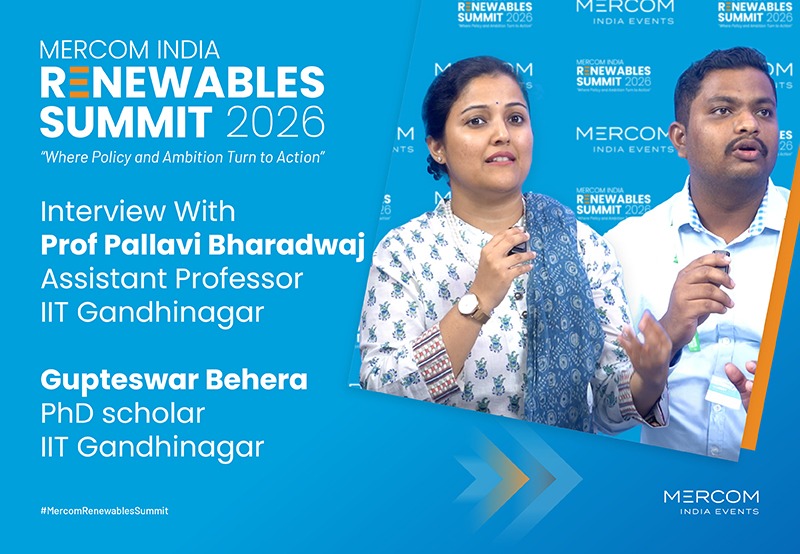
Artificial intelligence (AI) can help consumers design renewable energy systems, optimize energy assets, and improve operational efficiency using solutions tailored to Indian grid conditions, according to Dr. Pallavi Bharadwaj, Assistant Professor, Electrical Engineering, IIT Gandhinagar, and Gupteswar Behera, PhD Scholar at IIT Gandhinagar.
Smart Power Electronics Lab@IIT Gandhinagar received the Clean Energy Research Impact Award at the Mercom India Awards 2026 for their work on Vidyut AI. The platform combines power engineering, artificial intelligence, and consumer energy data to support renewable energy system design, predictive maintenance, energy management, and technology assessment.
In an interview on the sidelines of the Mercom India Renewables Summit 2026, held in New Delhi on July 1 and 2, Bharadwaj and Behera discussed Vidyut AI, an artificial intelligence platform developed at IIT Gandhinagar to support India’s energy transition through renewable energy system design, asset optimization, and energy management.
The following are edited excerpts from the interview.
What is Vidyut AI and what does it aim to achieve?
Vidyut AI started as an effort to accelerate India’s green energy transition by combining power engineering expertise with artificial intelligence and data. We wanted to develop solutions tailored to Indian conditions because imported technologies are often not optimized for the challenges we face.
India continues to experience issues such as grid variability, power quality, and the growing integration of renewable energy. We wanted to develop hardware and software together to address these challenges while also helping consumers transition to cleaner energy.
The platform has three major verticals. The first helps consumers design renewable energy systems and transition to green energy. The second focuses on energy management for consumers who already have solar, batteries, or other distributed energy resources by optimizing system operation, reducing emissions, and improving financial returns. The third evaluates different technology pathways through case studies, including batteries, hydrogen, grid-forming operation, black-start capability, and power quality improvements under Indian operating conditions.
How does Vidyut AI help someone planning to add renewable energy compared to someone who already has an existing energy system?
For consumers currently relying only on grid electricity, the platform analyzes their energy consumption and recommends the appropriate solar capacity, battery backup, and other technical and economic parameters, including expected returns on investment.
For consumers who already have renewable energy systems, the platform focuses on optimizing the operation of the entire energy system.
Many larger consumers operate multi-energy systems that include electricity, heating, cooling, water, gas, and heat pumps. In these cases, we build a digital twin of the system and perform multi-energy optimization so that consumers improve operating efficiency, improve asset life, reduce emissions, and improve overall financial performance.
Commercial and industrial consumers often operate under different electricity tariffs. How does Vidyut AI account for those differences?
Electricity tariffs vary significantly depending on the consumer and location. A system that is profitable in one location may not be economical somewhere else.
Artificial intelligence plays an important role in adapting to these changing conditions. We use techniques such as reinforcement learning, where the system continuously learns from operating patterns, electricity bills, and consumer behavior. As more operational data becomes available, the platform continuously refines its optimization strategy to increase consumer savings and profitability.
Many industries already use conventional energy management systems. What advantages does artificial intelligence provide, particularly for predictive maintenance?
Predictive maintenance is one of the most valuable applications of artificial intelligence.
Previously, maintenance schedules were often based on experience or fixed timelines. With continuous operational data, artificial intelligence can identify early signs of battery degradation, monitor state of charge and state of health, and recommend operational adjustments or replacement strategies.
An important objective of Vidyut AI is to use these assets more efficiently so they last longer. The platform can detect the point where degradation begins to accelerate and recommend operational changes before that occurs.
Can Vidyut AI work with existing monitoring systems, or does it require dedicated hardware?
The platform requires access to operational data through sensors or existing monitoring systems.
One approach is to deploy our own Internet of Things hardware. Our team also develops Internet of Things hardware and cybersecurity solutions to support that approach.
The second option is to integrate our software with existing systems where sufficient access to operational data is available. Both deployment models are supported.
Looking ahead, do you expect the platform to expand beyond customer-side applications?
We are currently focused on one side of the electricity ecosystem, but future energy systems will require greater flexibility across the entire value chain.
As the sector evolves, we expect to look at both sides of the system so that these technologies can deliver greater value across the electricity network.


Arjun Joshi
More articles from Arjun Joshi.